Last Updated: April 2026 | Written for beginners, students and engineers entering industrial automation and control systems.
A SCADA system is one of the most important technologies in modern industrial automation. Power stations, water treatment plants, oil pipelines, manufacturing lines, and national electricity grids all rely on SCADA systems to monitor and control their processes in real time. Yet for anyone new to industrial automation, SCADA can seem complex and confusing at first.
This complete guide explains exactly what a SCADA system is, how it works, what its components are, and where it is used — with real examples and plain language explanations designed for beginners.
In this SCADA guide you will learn:
- What SCADA stands for and what it actually does
- The 5 core components of every SCADA system
- How SCADA architecture works — from field devices to control room
- The 4 generations of SCADA — how the technology evolved
- Which industries use SCADA and real-world application examples
- The top SCADA software platforms used in industry today
- How SCADA relates to PLCs, RTUs, HMIs and DCS
- What SCADA engineers earn and how to start a career in SCADA
What Is SCADA? – Definition
SCADA stands for Supervisory Control and Data Acquisition. It is an industrial control system architecture that allows operators to monitor, control, and acquire data from industrial processes — both locally and remotely — from a centralized control room.
The key word in SCADA is supervisory. A SCADA system sits above the field control layer — it monitors what is happening in the process, raises alarms when something goes wrong, stores historical data, and allows operators to send supervisory commands. The actual real-time control is performed by the field devices — PLCs (Programmable Logic Controllers) and RTUs (Remote Terminal Units) — that the SCADA system connects to.
💡 Simple Definition: A SCADA system is the eyes, ears and brain of an industrial plant. It collects data from hundreds or thousands of sensors and field devices, displays it to operators in real time, raises alarms automatically, stores historical records, and allows operators to control the process remotely — all from one or more computer workstations in a control room.
What Does SCADA Stand For?
| Letter | Word | What It Means |
|---|---|---|
| S | Supervisory | Sits above the control layer — monitors and supervises |
| C | Control | Allows operators to send control commands to field devices |
| A | and | — |
| D | Data | Collects real-time data from sensors and controllers |
| A | Acquisition | Stores and processes acquired data for analysis and reporting |
What Is a SCADA System Used For?
A SCADA system performs four core functions in any industrial installation:
| Function | Description | Example |
|---|---|---|
| Data Acquisition | Collects real-time data from field sensors and PLCs/RTUs | Reading temperature, pressure, flow, level from transmitters |
| Supervisory Control | Allows operators to send commands to field devices from control room | Opening a valve, starting a pump, changing a setpoint |
| Alarm Management | Detects abnormal conditions and alerts operators immediately | High temperature alarm, pump failure alarm, low level alarm |
| Data Historian | Stores long-term historical data for trending, reporting and analysis | 30-day production trend, energy consumption report, audit trail |
The 5 Core Components of a SCADA System
1. SCADA Server (Master Station)
The SCADA server is the central hub of the entire system. It runs the SCADA software application, collects data from all field devices, processes alarms, stores data in the historian database, and serves information to operator workstations. In redundant systems there are two SCADA servers — one active, one on hot standby.
2. HMI – Human Machine Interface
The HMI is the graphical interface that operators use to interact with the SCADA system. It displays real-time process values, P&ID (Piping and Instrumentation Diagram) graphics, alarm lists, and trend charts. Modern HMIs run on industrial PC workstations with large monitors — in some systems they run in web browsers allowing access from any device on the plant network.
3. PLCs and RTUs (Field Controllers)
PLCs (Programmable Logic Controllers) and RTUs (Remote Terminal Units) are the field-level devices that connect directly to sensors, actuators, and process equipment. They execute local control logic and send process data to the SCADA server. The SCADA system does not control the field devices directly — it communicates with the PLCs and RTUs which then control the physical process.
For a complete guide to PLCs: What Is a PLC? Complete Beginner’s Guide
4. Communication Network
The communication network links all SCADA components together. For local plant networks this is typically industrial Ethernet — PROFINET or EtherNet/IP. For remote sites across large distances SCADA uses 4G/5G cellular, radio links, satellite, or leased-line WAN connections. The communication protocol used to exchange data between SCADA servers and field devices is most commonly OPC-UA, Modbus TCP, or DNP3.
5. Historian Database
The historian is a specialized time-series database that stores all process data with timestamps at high speed — millions of data points per day. Operators and engineers use the historian for production reporting, quality trending, energy analysis, regulatory compliance, and root-cause investigation after process upsets. Popular historians include OSIsoft PI (now AVEVA PI), Wonderware Historian, and Siemens SIMATIC Process Historian.
How Does a SCADA System Work?
Understanding how SCADA works requires understanding the flow of data from the field to the control room and back again:
| Step | What Happens | Who Does It |
|---|---|---|
| 1 | Field sensor measures process variable (temperature, pressure, flow, level) | Field transmitter / sensor |
| 2 | Sensor sends 4-20mA or digital signal to PLC/RTU | Field wiring / signal cable |
| 3 | PLC/RTU converts signal to digital data tag value | PLC analog input module |
| 4 | SCADA server polls PLC/RTU for data via communication network | SCADA communication driver |
| 5 | SCADA server processes data — checks alarms, stores to historian | SCADA server software |
| 6 | HMI workstation displays live data to operator | SCADA HMI client |
| 7 | Operator sends command (open valve, start pump) via HMI | Operator at HMI station |
| 8 | SCADA sends command to PLC/RTU via network | SCADA communication driver |
| 9 | PLC/RTU executes command — activates output to field device | PLC digital output module |
| 10 | Field actuator responds — valve opens, pump starts | Field actuator/motor |
SCADA System Architecture
SCADA architecture has evolved through four distinct generations since the 1960s:
| Generation | Era | Architecture | Key Technology |
|---|---|---|---|
| 1st Generation | 1960s-1970s | Monolithic — standalone mainframe computers | Analog telemetry, proprietary hardware |
| 2nd Generation | 1980s-1990s | Distributed — LAN-connected PC workstations | Local area networks, Windows PCs, modular PLCs |
| 3rd Generation | 2000s-2010s | Networked — WAN and internet connectivity | Ethernet, TCP/IP, OPC, remote access, ERP integration |
| 4th Generation | 2015-present | IIoT-integrated — cloud and edge computing | OPC-UA, cloud analytics, digital twins, AI/ML, cybersecurity |
Modern SCADA Architecture (2026)
Today’s SCADA systems follow a layered architecture aligned with the ISA-95 automation pyramid:
- Level 0 — Field: Sensors, actuators, transmitters, motors, valves
- Level 1 — Control: PLCs and RTUs executing real-time control logic
- Level 2 — SCADA: SCADA server, HMI workstations, historian database
- Level 3 — MES: Manufacturing Execution System — production scheduling and tracking
- Level 4 — ERP: Business systems — SAP, Oracle — enterprise planning
SCADA vs HMI – What Is the Difference?
HMI and SCADA are closely related but not the same:
| Feature | HMI | SCADA |
|---|---|---|
| Definition | The graphical screen/interface the operator sees | The complete system — server, HMI, historian, comms |
| Scope | One machine or local area | Entire plant, multiple sites, remote locations |
| Data storage | Limited — local only | Full historian — years of data |
| Number of tags | Hundreds to thousands | Thousands to hundreds of thousands |
| Remote access | Usually local only | Remote access from anywhere on network |
| Alarm management | Basic alarms only | Full alarm management with priorities and escalation |
| Example | Touch screen panel on a single machine | Control room with multiple screens monitoring entire plant |
💡 Simple Rule: An HMI is part of a SCADA system — but a SCADA system is much more than just an HMI. Every SCADA system has HMIs, but not every HMI is part of a SCADA system.
Industries That Use SCADA Systems
| Industry | SCADA Application | Example |
|---|---|---|
| Oil and Gas | Pipeline monitoring, compressor stations, wellhead control | Pipeline SCADA across thousands of km |
| Water and Wastewater | Pump stations, treatment plants, reservoir levels | City water distribution network monitoring |
| Power Generation | Turbine control, substation monitoring, grid management | National grid energy management system |
| Manufacturing | Production line monitoring, OEE tracking, quality data | Automotive assembly line SCADA |
| Food and Beverage | Batch control, temperature monitoring, CIP control | Brewery or dairy plant SCADA |
| Pharmaceutical | Batch records, environmental monitoring, FDA compliance | Drug manufacturing SCADA with 21 CFR Part 11 |
| Building Automation | HVAC, lighting, energy, access control | Airport or data centre building management |
| Mining | Conveyor systems, crusher control, ventilation | Underground mine SCADA system |
| Transportation | Traffic management, rail signalling, tunnel systems | Metro railway SCADA system |
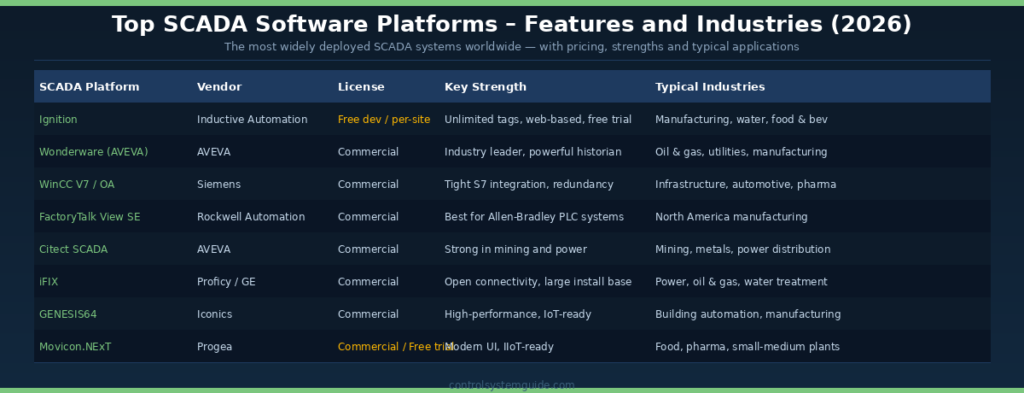
Top SCADA Software Platforms (2026)
[UPLOAD IMAGE HERE: what-is-scada-software.png — Alt text: top SCADA software platforms comparison Ignition Wonderware WinCC FactoryTalk 2026]
| Platform | Vendor | Key Strength | Best For |
|---|---|---|---|
| Ignition | Inductive Automation | Unlimited tags, web-based, free development mode | Manufacturing, water, food — flexible and cost-effective |
| Wonderware (AVEVA) | AVEVA | Industry leader — most widely installed globally | Oil and gas, utilities, large process plants |
| WinCC V7 / WinCC OA | Siemens | Tight S7 PLC integration, excellent redundancy | Automotive, infrastructure, critical systems |
| FactoryTalk View SE | Rockwell Automation | Best integration with Allen-Bradley PLCs | North American manufacturing — automotive, food |
| Citect SCADA | AVEVA | Strong alarm management, proven in harsh environments | Mining, metals, power distribution |
| iFIX | Proficy / GE Digital | Open OPC connectivity, large global install base | Power generation, oil and gas, water treatment |
| GENESIS64 | Iconics | High performance, modern UI, strong IoT integration | Building automation, smart manufacturing |
Free SCADA Software to Learn With
You can learn SCADA programming without spending any money:
- Ignition — full featured with unlimited development mode — free forever for learning
- Siemens WinCC — free trial version available for learning TIA Portal SCADA
- Movicon.NExT — free trial version with full features for learning
SCADA Communication Protocols
| Protocol | Used For | Common In |
|---|---|---|
| OPC-UA | Modern standard for SCADA-PLC data exchange — platform independent | All modern SCADA platforms — the future standard |
| Modbus TCP | Simple, widely supported — SCADA reads registers from PLCs/RTUs | Water, power, legacy systems — very widely used |
| DNP3 | Reliable protocol for remote sites — handles communication failures gracefully | Power utilities, water, oil and gas pipelines |
| PROFINET | High-speed Siemens network — SCADA server reads S7 PLCs via OPC | Siemens-based plants in Europe and globally |
| EtherNet/IP | Allen-Bradley network — FactoryTalk reads CompactLogix/ControlLogix | Rockwell-based plants in North America |
| IEC 60870-5 | Power utility protocol — substation to SCADA communication | National power grid SCADA systems |
According to the International Society of Automation (ISA), OPC-UA is now the internationally recognized standard for industrial data exchange between SCADA systems and field devices, replacing older proprietary protocols.
SCADA System Career and Salary
| Role | US Salary Range | UK Salary Range | Skills Required |
|---|---|---|---|
| SCADA Technician | $55,000 – $75,000 | £28,000 – £42,000 | HMI operation, basic configuration, troubleshooting |
| SCADA Engineer | $75,000 – $105,000 | £42,000 – £65,000 | System design, PLC integration, historian, networking |
| Senior SCADA Engineer | $105,000 – $140,000 | £65,000 – £90,000 | Architecture, cybersecurity, project management |
| SCADA System Architect | $130,000 – $180,000+ | £80,000 – £120,000+ | Full system design, OT/IT integration, multi-site |
How to Start a SCADA Career
- Learn PLC programming first — SCADA connects to PLCs so you must understand them: How to Learn PLC Programming
- Download Ignition free — install the free Ignition designer and build a basic HMI screen
- Connect to a PLC simulator — link Ignition to Codesys or PLCSIM to see live data on screen
- Learn OPC-UA — understand how SCADA reads data from PLCs via OPC server
- Build a portfolio project — a complete SCADA demo with HMI, alarms, trends and historian
Frequently Asked Questions – What Is SCADA?
What does SCADA stand for?
SCADA stands for Supervisory Control and Data Acquisition. It is an industrial control system architecture that monitors and controls industrial processes from a centralized location. The supervisory level means the SCADA system sits above the field control devices — PLCs and RTUs — collecting their data, displaying it to operators, managing alarms, and storing historical records.
What is a SCADA system used for?
A SCADA system is used to monitor and control industrial processes in real time from a centralized control room. It collects data from field sensors and controllers, displays process information to operators on HMI screens, raises alarms when process conditions go outside normal limits, stores long-term historical data for reporting and analysis, and allows operators to send supervisory control commands to field devices.
What is the difference between SCADA and HMI?
An HMI (Human Machine Interface) is a single graphical screen that displays information about one machine or local process area. A SCADA system is a complete architecture that includes one or more HMI workstations plus a SCADA server, historian database, communication network, and connections to PLCs and RTUs across an entire plant or multiple remote sites. Every SCADA system contains HMIs but an HMI alone is not a SCADA system.
What is the difference between SCADA and DCS?
SCADA is designed for wide-area supervisory monitoring and control of geographically distributed processes — it connects to PLCs and RTUs across large distances. DCS (Distributed Control System) is designed for integrated real-time process control within a single plant — the DCS controllers execute all control loops directly with millisecond response times. SCADA is typically used for pipelines, power grids and water networks. DCS is used for chemical plants, refineries and pharmaceutical manufacturing. For the full comparison: SCADA vs DCS Guide.
What industries use SCADA?
SCADA systems are used across virtually every industry that involves industrial automation. The largest users are oil and gas pipelines, water treatment and distribution networks, power generation and transmission grids, manufacturing plants, food and beverage processing, pharmaceutical manufacturing, mining operations, building automation systems, transportation infrastructure, and wastewater management systems.
What is the best SCADA software for beginners?
Ignition by Inductive Automation is the best SCADA software for beginners because it is completely free to use in development and learning mode with no tag count limits. It has a modern web-based interface, excellent documentation, and a large community of users. Ignition connects to PLCs via OPC-UA and Modbus TCP and includes a full historian, alarm system, and reporting module — all the core SCADA functions beginners need to learn.
What is OPC-UA in SCADA?
OPC-UA (Open Platform Communications Unified Architecture) is the international standard communication protocol used to exchange data between SCADA systems and PLCs or other field devices. It replaces older OPC Classic protocols and provides secure, platform-independent data exchange over standard Ethernet networks. In modern SCADA installations the OPC-UA server runs on the PLC or a gateway and the SCADA software connects as an OPC-UA client to read and write process data tags.
How much do SCADA engineers earn?
SCADA engineers in the United States typically earn between $75,000 and $140,000 per year depending on experience, location, and industry. Entry-level SCADA technicians start at $55,000 to $75,000. Senior SCADA engineers and system architects with 10 or more years of experience earn $130,000 to $180,000 or more. In the UK salary ranges are approximately £42,000 to £90,000 for SCADA engineer roles. SCADA skills are in high demand globally across all industrial sectors.
Conclusion
A SCADA system is the centralized monitoring and control backbone of modern industrial automation. From a national power grid monitoring thousands of substations to a single water treatment plant managing dozens of pump stations — SCADA provides real-time visibility, alarm management, historical data, and supervisory control that keeps critical infrastructure running safely and efficiently.
Key points to remember about SCADA systems:
- SCADA = Supervisory Control and Data Acquisition — monitors and controls from above the field level
- 5 core components — server, HMI, PLCs/RTUs, communication network, historian
- SCADA supervises — PLCs control — the PLC executes real-time logic, SCADA watches and commands
- Used everywhere — oil, gas, water, power, manufacturing, pharma, mining, transport
- OPC-UA is the standard — modern SCADA communicates with PLCs via OPC-UA
- Ignition is free to learn — start building SCADA skills today at no cost
Related Guides:
- PLC vs DCS vs SCADA – Full Three-Way Comparison Guide
- SCADA vs DCS – Key Differences and When to Use Each
- What Is a PLC? Complete Beginner’s Guide
- PLC Inputs and Outputs – DI, DO, AI, AO Complete Guide

Automation engineer based in Asia, with hands-on experience in PLC programming, SCADA, and industrial control systems across oil and gas, power, food and beverage, and water industries. Writes about PLC fundamentals, ladder logic, vendor-specific instruction sets for Siemens, Allen-Bradley, and other major platforms, and industrial communication protocols.