Last Updated: April 2026 | Written for beginners entering industrial automation and PLC programming.
A PLC — Programmable Logic Controller — is the brain behind almost every machine and automated process in modern industry. From the conveyor belt at your local supermarket to the turbines in a power station, PLCs are running silently in the background, controlling everything.
In this complete what is a PLC beginner’s guide you will learn: you will learn:
- What a PLC is and what PLC stands for — explained simply
- How a PLC works — the scan cycle explained step by step
- Every hardware component inside a PLC and what it does
- Types of PLCs — from micro to large modular rack systems
- Where PLCs are used in real industries with examples
- PLC vs relay control — why PLCs replaced relay panels
- How to start learning PLC programming as a complete beginner
What Is a PLC? Definition of a Programmable Logic Controller
A PLC (Programmable Logic Controller) is a specialized industrial computer designed to control machines and automated processes in real time. It continuously reads input signals from field devices such as sensors, switches, and push buttons, executes a control program to make decisions, and sends output signals to control motors, valves, lights, and other equipment.
To fully answer what is a PLC, the key difference between a PLC and a regular computer is that a PLC is built specifically for industrial environments. It operates reliably in conditions that would destroy a standard computer — extreme temperatures, constant vibration, electrical noise, dust, and humidity. PLCs run continuously, 24 hours a day, 7 days a week, often for years without interruption.
💡 Simple Definition: A PLC is an industrial computer that reads inputs from sensors, makes decisions based on a program, and controls outputs like motors and valves — repeating this process thousands of times per second.
Today, PLCs control everything from assembly lines and packaging machines to oil refineries and power stations. The global PLC market is worth over $13 billion and is used in over 80% of industrial automation systems worldwide.
What Does PLC Stand For?
PLC stands for Programmable Logic Controller. Each word has a specific meaning:
| Word | Meaning | What It Means in Practice |
|---|---|---|
| Programmable | Can be programmed and reprogrammed | Control logic is changed via software, not rewiring |
| Logic | Makes decisions based on rules | IF sensor is ON THEN start motor — logical decisions |
| Controller | Controls industrial equipment | Directly operates motors, valves, actuators, alarms |
Before PLCs existed, factories used thousands of hardwired electromagnetic relays to control machines. Changing how a machine operated meant physically rewiring entire control panels — weeks of downtime and enormous cost. The PLC replaced all of that with software that can be changed in hours.
A Brief History — Who Invented the PLC?
Before answering what is a PLC fully, it helps to know the PLC was invented on New Year’s Day 1968 by an American engineer named Dick Morley, often called the “Father of the PLC.” Working at Bedford Associates, Morley wrote the complete specification for a programmable controller — a device that would replace relay logic and survive factory conditions.
His company formed Modicon (Modular Digital Controller) and shipped the first PLC, the Model 084, in 1969. General Motors placed the first million-dollar order, using the new controller in their Hydramatic Division. Within a year, the PLC had gone from a concept to deployment at the world’s largest automaker.
| Year | Milestone |
|---|---|
| 1968 | Dick Morley writes PLC specification at Bedford Associates |
| 1969 | Modicon Model 084 — first PLC — ships to General Motors |
| 1973 | Modicon 184 — first commercially successful PLC |
| 1979 | Allen-Bradley enters market — PLC becomes industry standard |
| 1993 | IEC 61131-3 standard published — defines 5 programming languages |
| 2000s | Ethernet connectivity — PLCs connect to SCADA and networks |
| 2020s | IIoT integration — PLCs connect to cloud and data analytics |
| 2025 | IEC 61131-3 fourth edition — IL removed, OOP support added |
How Does a PLC Work?
A PLC works by continuously executing a repeating loop called the scan cycle. This cycle has 4 stages and completes in 1–20 milliseconds — fast enough to control any industrial process in real time.
| Stage | What the PLC Does | Example |
|---|---|---|
| 1. Input Scan | Reads all physical input signals and stores them in memory | Reads: start button ON, stop button OFF, sensor ON |
| 2. Program Execution | Executes all rungs of the control program top to bottom | Evaluates: IF start AND NOT stop THEN motor = ON |
| 3. Output Scan | Writes all output states to physical devices | Sends: 24VDC to motor contactor coil |
| 4. Housekeeping | Communication, diagnostics, memory management | Updates SCADA data, checks for faults |
This cycle repeats continuously while the PLC is in RUN mode — thousands of times per minute. The PLC never stops. It never crashes. It executes the exact same program the exact same way every single time — this is called deterministic behaviour and it is what makes PLCs safe for industrial control.
💡 Key Insight: What sets PLCs apart from standard computers is not processing power — your smartphone is far more powerful. What sets them apart is reliability and determinism — a PLC executes its program exactly the same way every scan, with no background processes, no operating system updates, and no unexpected behaviour.
PLC Hardware Components Explained
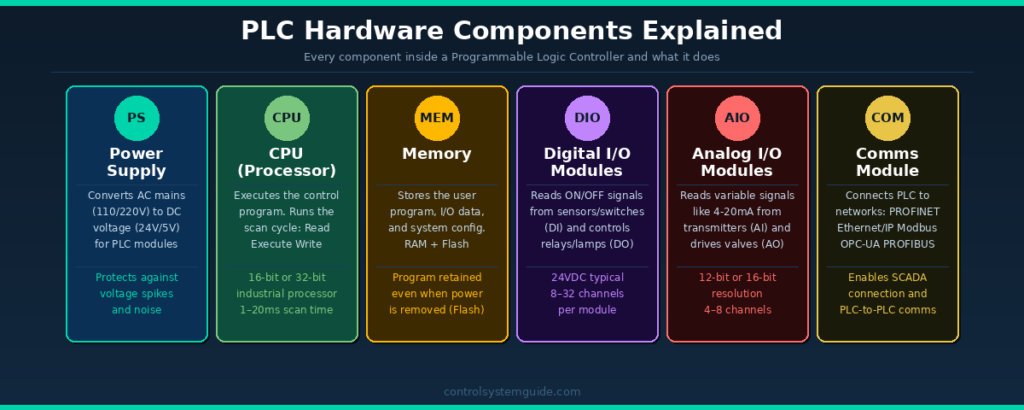
A PLC system consists of several hardware components, each with a specific function:
1. Power Supply – Essential Component of What Is a PLC
The power supply converts mains AC voltage (110V or 220V) into the DC voltages required by the PLC modules (typically 24VDC and 5VDC). It also provides protection against voltage spikes and electrical noise. Without a stable power supply, the PLC cannot operate reliably.
2. CPU (Central Processing Unit)
The CPU is the brain of the PLC. It contains the microprocessor that executes the control program, manages memory, runs the scan cycle, and handles communication with other devices. Modern PLC CPUs use industrial-grade processors designed for temperature extremes and long-term reliability. Typical scan times are 1–20 milliseconds.
3. Memory
PLC memory stores three types of data: the user program (ladder logic or other IEC languages), the I/O data table (current state of all inputs and outputs), and system configuration data. Modern PLCs use Flash memory to retain the program even when power is removed, and RAM for fast execution during operation.
4. Digital Input/Output Modules (DI/DO)
Digital I/O modules handle ON/OFF signals. Digital Input modules read signals from field devices — push buttons, limit switches, proximity sensors, and relay contacts (typically 24VDC). Digital Output modules send ON/OFF signals to control devices — motor contactors, solenoid valves, indicator lamps, and alarm horns. Each module typically provides 8–32 channels.
5. Analog Input/Output Modules (AI/AO)
Analog I/O modules handle continuously variable signals. Analog Input modules read signals from transmitters — temperature, pressure, flow, and level instruments (typically 4–20mA or 0–10VDC). Analog Output modules send variable signals to control devices — control valves, variable frequency drives (VFDs), and proportional valves. Resolution is typically 12-bit or 16-bit.
6. Communication Modules
Communication modules connect the PLC to industrial networks and other systems. Common protocols include PROFINET (Siemens standard), Ethernet/IP (Rockwell standard), Modbus TCP, OPC-UA, PROFIBUS, and DeviceNet. Communication modules enable PLCs to exchange data with SCADA systems, HMIs, other PLCs, and cloud platforms.
| Component | Function | Typical Specification |
|---|---|---|
| Power Supply | Converts AC to DC power | 24VDC, 5A–20A output |
| CPU | Executes control program | 1–20ms scan time |
| Digital Input | Reads ON/OFF signals | 24VDC, 8–32 channels |
| Digital Output | Controls ON/OFF devices | 24VDC or relay, 8–32 channels |
| Analog Input | Reads variable signals | 4–20mA or 0–10V, 4–8 channels |
| Analog Output | Controls variable devices | 4–20mA or 0–10V, 2–4 channels |
| Comms Module | Network connectivity | PROFINET, Ethernet/IP, Modbus |
Types of PLCs
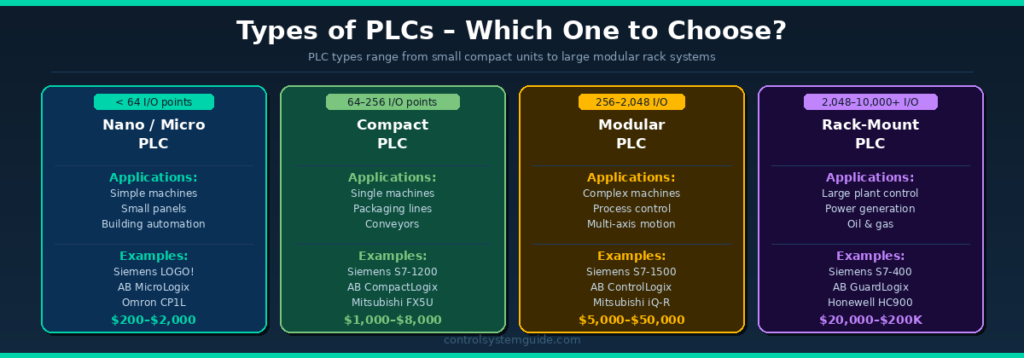
PLCs come in four main types, ranging from small compact units to large rack-mounted systems:
1. Nano/Micro PLC (Under 64 I/O)
The smallest PLCs, designed for simple control tasks with limited I/O requirements. Fixed I/O — inputs and outputs are built into the unit and cannot be expanded. Used for simple machines, small panels, and building automation.
Examples: Siemens LOGO!, Allen-Bradley MicroLogix 1100, Omron CP1L, Schneider Zelio
Typical cost: $200–$2,000
2. Compact PLC (64–256 I/O)
The most widely used PLC type in industry. Modular design allows I/O expansion by adding modules. Fast processing, excellent connectivity, and supports all IEC programming languages. Suitable for single machines and production cells.
Examples: Siemens S7-1200, Allen-Bradley CompactLogix, Mitsubishi FX5U, Omron NX1P2
Typical cost: $1,000–$8,000
3. Modular PLC (256–2,048 I/O)
High-performance PLCs for complex machines and process control. Rack-based design with multiple CPU options, extensive I/O capacity, and advanced communication. Supports motion control, safety functions, and plant-wide networking.
Examples: Siemens S7-1500, Allen-Bradley ControlLogix, Mitsubishi iQ-R, Omron NX7
Typical cost: $5,000–$50,000
4. Large/Rack-Mount PLC (2,048+ I/O)
Enterprise-scale PLCs for large plant control, power generation, and oil and gas applications. Thousands of I/O points, redundant CPUs, redundant power supplies, and full safety integration. Often used alongside or as part of DCS systems.
Examples: Siemens S7-400/S7-410, Allen-Bradley GuardLogix 5580, Honeywell HC900
Typical cost: $20,000–$200,000+
Where Are PLCs Used? — Real Industry Examples
| Industry | What the PLC Controls | Why PLC? |
|---|---|---|
| Automotive | Robotic welding, press control, paint lines, conveyor systems | High speed, precise timing, reliability |
| Food & Beverage | Filling machines, pasteurizers, conveyor sorting, packaging | Hygienic design, recipe control, speed |
| Oil & Gas | Pipeline control, pump stations, compressor control, ESD systems | Safety-critical, remote operation |
| Water Treatment | Pump control, valve sequencing, dosing systems, level control | Continuous process, remote monitoring |
| Power Generation | Boiler control, turbine sequencing, substation automation | High reliability, safety interlocks |
| Pharmaceuticals | Batch mixing, filling lines, CIP/SIP systems, environmental control | FDA compliance, audit trails, precision |
| Mining | Conveyor systems, crusher control, hoisting equipment | Harsh environment, remote locations |
| Building Automation | HVAC control, elevator sequencing, lighting control, access control | Energy efficiency, centralized control |
What Is a PLC vs Relay-Based Control Systems?
Before PLCs, all industrial control was done using hardwired electromagnetic relays. Understanding why PLCs replaced relays helps explain what makes PLCs so valuable.
| Feature | Relay Control | PLC Control |
|---|---|---|
| Changing logic | Rewire entire panel — days of downtime | Edit software — hours or minutes |
| Physical size | Large relay panel — hundreds of components | Compact DIN rail mount — one unit |
| Reliability | Mechanical contacts wear out — frequent failures | No moving parts — decades of operation |
| Troubleshooting | Trace physical wires — slow and difficult | Online monitoring — see logic in real time |
| Scalability | Adding functions requires more relays and wiring | Add I/O modules and update software |
| Data logging | Not possible | Full process data available for SCADA |
| Cost (large systems) | High — many components, complex wiring | Lower — one PLC replaces thousands of relays |
| Energy consumption | High — each relay draws power constantly | Low — efficient solid-state components |
PLCs have almost completely replaced relay control in modern industrial automation. Relay control is still used in specific applications where simplicity and fail-safe behaviour are critical — for example, emergency stop circuits still often use hardwired relays as a final layer of safety.
Leading Programmable Logic Controller Manufacturers
| Manufacturer | Country | Popular Models | Market Strength |
|---|---|---|---|
| Siemens | Germany | S7-1200, S7-1500, S7-400 | Europe, Asia, global process industries |
| Allen-Bradley (Rockwell) | USA | CompactLogix, ControlLogix, MicroLogix | North America, automotive, food & beverage |
| Mitsubishi Electric | Japan | MELSEC iQ-R, FX5U, Q-Series | Asia, automotive, semiconductor |
| Omron | Japan | NX/NJ Series, CP1L, CJ2M | Asia, electronics manufacturing |
| Schneider Electric | France | Modicon M340, M580, TM221 | Europe, water & energy |
| Beckhoff | Germany | CX series, EK/EL I/O | PC-based control, motion, IIoT |
To compare PLC programming software for each brand, read: Best PLC Programming Software for Beginners
How Is a Programmable Logic Controller Programmed?
PLCs are programmed using the IEC 61131-3 standard which defines 5 programming languages. The most widely used is Ladder Logic — a graphical language that resembles electrical relay circuits and is easy for electricians to learn.
| Language | Type | Best For |
|---|---|---|
| Ladder Logic (LD) | Graphical | Machine control, interlocks, most common |
| Function Block (FBD) | Graphical | Process control, PID loops |
| Structured Text (ST) | Text | Complex calculations, data handling |
| Sequential Function Chart (SFC) | Graphical | Batch and sequential processes |
To learn PLC programming step by step, read: PLC Ladder Logic Tutorial – 7 Real Industrial Examples
For a full explanation of all 5 languages: PLC Programming Languages – Complete Guide
PLC vs DCS vs SCADA — What’s the Difference?
Many beginners confuse PLCs with DCS and SCADA systems. Here’s the quick difference:
| System | What It Does | Scale |
|---|---|---|
| PLC | Controls individual machines and processes directly | Machine level |
| DCS | Coordinates control across an entire plant | Plant level |
| SCADA | Monitors and supervises all systems from a control room | Site/enterprise level |
For a complete comparison: PLC vs DCS vs SCADA – Full Comparison Guide
How to Start Learning What Is a PLC and PLC Programming
If you are asking what is a PLC and where to start, follow this proven learning path:
| Step | What to Do | Time |
|---|---|---|
| 1 | Learn basic electrical concepts — inputs, outputs, switches, relays | Week 1–2 |
| 2 | Install free PLC software — Codesys or LogixPro simulator | Week 2 |
| 3 | Learn Ladder Logic basics — contacts, coils, timers, counters | Week 3–4 |
| 4 | Build simple programs — motor start/stop, conveyor control | Month 2 |
| 5 | Learn PLC inputs and outputs — DI, DO, AI, AO signal types | Month 2 |
| 6 | Choose a PLC brand — Siemens TIA Portal or Rockwell Studio 5000 | Month 3 |
| 7 | Practice on real or simulated projects | Month 3–6 |
For a detailed step-by-step learning plan: How to Learn PLC Programming from Scratch
Best free software to start: 10 Best PLC Programming Software for Beginners
Frequently Asked Questions – What Is a PLC?
What is a PLC in simple terms?
A PLC (Programmable Logic Controller) is an industrial computer that controls machines and automated processes. It reads inputs from sensors and switches, runs a control program to make decisions, and controls outputs like motors and valves. It repeats this process thousands of times per second, making it the reliable brain of industrial automation systems.
What does PLC stand for?
PLC stands for Programmable Logic Controller. Programmable means the control logic is set through software. Logic means it makes decisions based on programmed rules. Controller means it controls industrial equipment such as motors, valves, conveyors, and alarms.
Who invented the PLC?
The PLC was invented by Dick Morley on New Year’s Day 1968. Working at Bedford Associates, Morley wrote the complete specification for a programmable controller that would replace hardwired relay systems. His company formed Modicon and shipped the first PLC, the Model 084, to General Motors in 1969. Morley is known as the Father of the PLC.
What is the difference between a PLC and a regular computer?
A PLC is built specifically for industrial control while a regular computer is a general-purpose device. PLCs are designed to withstand extreme temperatures, vibration, dust, and electrical noise. They execute programs in a deterministic, repeating scan cycle with no background processes or operating system interruptions. Regular computers can crash or behave unpredictably — PLCs are designed never to fail.
What are the main components of a PLC?
The main components of a PLC are the power supply (converts AC to DC power), the CPU (executes the control program), memory (stores the program and I/O data), digital input modules (reads ON/OFF signals from sensors), digital output modules (controls ON/OFF devices), analog input modules (reads variable signals from transmitters), analog output modules (controls variable devices), and communication modules (connects to networks and SCADA).
What industries use PLCs?
PLCs are used in virtually every industry that requires automated control. Major industries include automotive manufacturing, food and beverage production, oil and gas, water and wastewater treatment, power generation, pharmaceuticals, mining, building automation, and semiconductor manufacturing. Over 80 percent of industrial automation worldwide uses PLCs.
What programming language is used for PLCs?
PLCs are programmed using languages defined by the IEC 61131-3 standard. The most widely used language is Ladder Logic (Ladder Diagram), which uses graphical symbols resembling electrical relay circuits. Other languages include Function Block Diagram (FBD) for process control, Structured Text (ST) for complex calculations, and Sequential Function Chart (SFC) for batch processes.
How long does it take to learn PLC programming?
A complete beginner can learn the basics of PLC programming — ladder logic, timers, counters, and simple motor control — within 4 to 8 weeks of consistent practice using free simulation software. Becoming job-ready as a PLC programmer typically takes 6 to 12 months of learning and hands-on project work. Professional PLC engineers continue learning throughout their careers as technology evolves.
Conclusion
A PLC is the foundation of modern industrial automation. Understanding what a PLC is, how it works, and where it is used gives you the essential knowledge needed to begin your journey in industrial automation and control systems engineering.
Now you know what is a PLC. Here are the key points to remember about programmable logic controllers:
- A PLC reads inputs, executes a program, and controls outputs — repeating this scan cycle thousands of times per second
- PLCs are built for industrial environments — reliable, deterministic, and durable
- They replaced hardwired relay panels with flexible, software-based control
- Ladder Logic is the most widely used programming language — easy to learn for beginners
- PLCs are used in every major industry worldwide
Now that you know what is a PLC, ready to start learning? Begin here? Begin here:
- PLC Ladder Logic Tutorial – 7 Real Industrial Examples
- PLC Inputs and Outputs – DI, DO, AI, AO Explained
- PLC Programming Languages – All 5 Explained
- How to Learn PLC Programming from Scratch

Automation engineer based in Asia, with hands-on experience in PLC programming, SCADA, and industrial control systems across oil and gas, power, food and beverage, and water industries. Writes about PLC fundamentals, ladder logic, vendor-specific instruction sets for Siemens, Allen-Bradley, and other major platforms, and industrial communication protocols.