
Last Updated: April 2026 | Written for automation engineers and beginners selecting PLC hardware for industrial projects.
When selecting a PLC for an industrial automation project, the first decision every engineer faces is: compact PLC or modular PLC? Both types perform the same fundamental function — reading inputs, executing logic, and controlling outputs — but they differ significantly in construction, flexibility, cost, and the type of applications they are best suited for.
In this complete compact vs modular PLC guide you will find:
- Clear explanation of what compact and modular PLCs are — with real brand examples
- A full feature-by-feature comparison table covering 10 key factors
- Real brand examples — Siemens S7-1200 vs S7-1500 and CompactLogix vs ControlLogix
- A practical decision guide — which type to choose for your specific application
- The advantages and disadvantages of each type explained honestly
- How IO capacity, cost, maintenance and scalability differ between both types
Compact vs Modular PLC – What Is a Modular PLC?
A compact PLC — also called a fixed PLC or all-in-one PLC — is a programmable logic controller where the CPU, power supply, and input/output modules are all integrated into a single housing unit. Everything you need to run a basic control system is contained within one piece of hardware.
Compact PLCs are designed for simplicity and cost-effectiveness. They are ideal for applications with a defined, stable IO count where future expansion is not required. The most widely used compact PLCs in the world include the Siemens S7-1200 and the Allen-Bradley CompactLogix 5380.
| Component | In Compact PLC | Location |
|---|---|---|
| CPU (Processor) | ✅ Built in | Integrated into main housing |
| Power Supply | ✅ Built in | Integrated — powers CPU and IO |
| Digital IO | ✅ Built in | Fixed channels on CPU unit |
| Analog IO | ✅ Built in (some models) | Fixed AI channels on CPU (varies by model) |
| Communication | ✅ Built in | PROFINET or EtherNet/IP port on CPU |
| Signal Modules | ⚠️ Limited expansion | Side-mounted expansion modules |
| Rack/Backplane | ❌ Not used | Not applicable |
💡 Key Fact: The Siemens S7-1200 CPU 1214C has 14 digital inputs, 10 digital outputs, and 2 analog inputs built directly into the CPU housing — plus support for up to 8 expansion signal modules. This is the most widely used compact PLC in the world. Read our full Siemens S7-1200 Tutorial for complete programming and setup guide.
Compact vs Modular PLC – What Is a Modular PLC?What Is a Modular PLC?
A modular PLC — also called a rack-based PLC — is a programmable logic controller where the CPU, power supply, IO modules, and communication modules are all separate individual units mounted on a common rack or backplane. The rack provides the power distribution and data bus that connects all modules together.
Modular PLCs are designed for flexibility and scalability. You add exactly the modules you need — no more, no less — and can expand the system later by adding more modules or additional racks. The most widely used modular PLCs include the Siemens S7-1500 and the Allen-Bradley ControlLogix 5580.
| Component | In Modular PLC | Location |
|---|---|---|
| CPU (Processor) | ✅ Separate module | Slots into rack — replaceable individually |
| Power Supply | ✅ Separate module | Slots into rack — replaceable individually |
| Digital IO | ✅ Separate DI/DO modules | Any rack slot — mix 16ch, 32ch modules |
| Analog IO | ✅ Separate AI/AO modules | Any rack slot — 4ch, 8ch options |
| Communication | ✅ Separate comm modules | PROFIBUS, PROFINET IO, Modbus, safety modules |
| Expansion | ✅ Unlimited | Add racks — hundreds of IO points possible |
| Rack/Backplane | ✅ Required | Provides power bus and data bus for all modules |
Compact vs Modular PLC – Complete Comparison Table
| Feature | Compact PLC | Modular PLC |
|---|---|---|
| Construction | All-in-one single unit | Separate modules on rack/backplane |
| IO capacity | Fixed — typically 10 to 284 IO | Unlimited — add modules as needed |
| Expandability | Limited — only side expansion modules | Fully expandable — add racks and modules |
| Upfront cost | Lower — one unit purchase | Higher — CPU + PSU + rack + modules |
| Long-term cost | Higher if system must be replaced to expand | Lower — only buy modules you need |
| Panel space | Compact — very small footprint | Larger — rack takes more cabinet space |
| Maintenance | Replace entire unit if CPU fails | Replace only the failed module |
| Wiring complexity | Simple — fewer terminals | More complex — each module wired separately |
| Communication options | Built-in PROFINET or EtherNet/IP | Any protocol via dedicated comm modules |
| Processing power | Moderate — suits most machine control | High — suited for complex process control |
| Safety integration | Limited — some models have safety variant | Full — dedicated F-CPU and F-IO modules |
| Motion control | Basic — up to 4 axes typically | Advanced — many axes with motion modules |
| Best for | Machines, standalone systems, OEMs | Production lines, process plants, infrastructure |
| Siemens example | S7-1200 (CPU 1211C to 1217C) | S7-1500 (CPU 1511 to 1518) |
| Rockwell example | CompactLogix 5380 | ControlLogix 5580 |
| Mitsubishi example | MELSEC iQ-F series | MELSEC iQ-R series |
Real Brand Examples – Compact vs Modular
The following brand comparisons are based on Siemens official PLC product documentation and publicly available specifications.
Siemens – S7-1200 (Compact) vs S7-1500 (Modular)
| Feature | Siemens S7-1200 | Siemens S7-1500 |
|---|---|---|
| Type | Compact | Modular |
| Built-in IO | 14 DI / 10 DQ / 2 AI (CPU 1214C) | None — all IO via separate modules |
| Max IO | Up to 284 IO with signal modules | Unlimited — multiple racks |
| Work memory | Up to 150KB (CPU 1217C) | Up to 5MB (CPU 1518) |
| Motion axes | Up to 4 basic motion axes | Up to 128 axes with motion modules |
| Safety (F-CPU) | FC variant available for S7-1200 | Full F-CPU and F-IO module range |
| Display | No built-in display | Built-in front panel display |
| Typical application | Machines, packaging, conveyors | Process plants, large production lines |
| Approximate entry cost | €300-600 for starter CPU | €800-2,000+ for CPU + rack + PSU |
Allen-Bradley – CompactLogix (Compact) vs ControlLogix (Modular)
| Feature | CompactLogix 5380 | ControlLogix 5580 |
|---|---|---|
| Type | Compact | Modular |
| Max local IO | Up to 31 modules | Unlimited racks |
| Memory | Up to 4MB user memory | Up to 40MB user memory |
| Tasks supported | Up to 32 tasks | Up to 100 tasks |
| Motion control | Up to 16 servo axes | Up to 256 servo axes |
| Safety | GuardLogix variant available | Full GuardLogix safety controller |
| Redundancy | Not supported | ✅ Full CPU redundancy available |
| Typical application | OEM machines, packaging, material handling | Automotive, oil and gas, large process plants |
Compact vs Modular PLC – Decision Guide
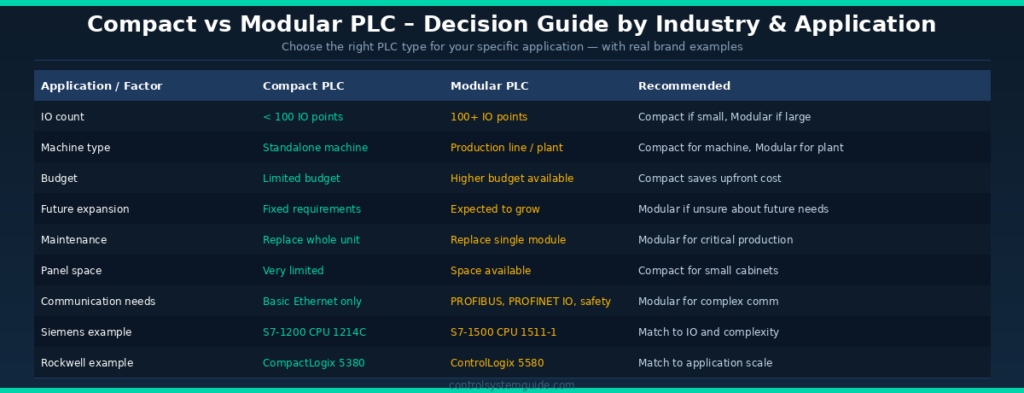
Choose a Compact PLC When:
- Your IO count is below 100 points and unlikely to grow significantly
- You are building a standalone machine or OEM equipment
- Budget is the primary constraint — compact PLCs cost 50-70% less upfront
- Panel space is very limited
- The application is straightforward — conveyors, packaging, small process
- You want quick installation with minimal configuration
- You are a machine builder supplying to multiple end users (standardization matters)
Choose a Modular PLC When:
- Your IO count exceeds 100 points or is expected to grow
- You are building a production line, process plant, or facility-wide system
- You need specialized modules — safety F-IO, high-speed counter, motion, analog precision
- The system must be expanded or modified without replacing the entire controller
- Redundancy is required — CPU redundancy for critical production systems
- Advanced motion control with more than 4-8 axes is required
- Long-term total cost of ownership is more important than upfront cost
💡 Decision Rule: If you are building a machine — use a compact PLC. If you are building a plant — use a modular PLC. When in doubt, ask: “Will I need more IO or new functionality in 3 years?” If yes — go modular. If no — go compact.
Compact vs Modular PLC – Advantages of Compact PLCs
| Advantage | Detail | Impact |
|---|---|---|
| Lower upfront cost | One unit purchase vs rack + CPU + PSU + modules | 50-70% cheaper for small systems |
| Faster installation | Fewer components to mount and wire | Saves 1-3 days on small projects |
| Smaller footprint | Fits in very small control panels | Critical for machine-mounted panels |
| Simpler configuration | Less hardware to configure in software | Faster commissioning |
| Lower spare parts cost | One unit to stock as spare | Simpler spare parts management |
| Built-in IO | IO available immediately without extra modules | Faster project start |
Disadvantages of Compact PLCs
| Disadvantage | Detail | When This Matters |
|---|---|---|
| Limited IO expansion | Maximum IO is fixed by CPU model chosen | When projects grow beyond initial spec |
| Full unit replacement on CPU failure | CPU and IO are one unit — cannot separate | Critical production where downtime is costly |
| Limited specialist modules | Fewer options for safety, motion, special IO | Advanced applications need modular |
| No redundancy | Most compact PLCs do not support CPU redundancy | High-availability systems |
Compact vs Modular PLC – Advantages of Modular PLCs
| Advantage | Detail | Impact |
|---|---|---|
| Unlimited expandability | Add modules and racks as needed indefinitely | System grows with the application |
| Individual module replacement | Replace only the failed module — no downtime to rewire everything | Faster maintenance, less production loss |
| Full specialist module range | Safety F-IO, high-speed counter, motion, temperature, weighing | Handles the most demanding applications |
| Higher processing power | High-end CPUs for complex programs and fast scan times | Handles large programs without performance issues |
| CPU redundancy | Dual CPU hot-standby for critical systems | Zero downtime even during CPU failure |
| Better long-term value | Add only what you need when you need it | Avoids costly full-system replacement |
Disadvantages of Modular PLCs
| Disadvantage | Detail | When This Matters |
|---|---|---|
| Higher upfront cost | Rack + CPU + PSU + modules add up quickly | Small systems — compact is better value |
| More panel space required | Rack systems need significantly more cabinet space | Machine-mounted panels with tight constraints |
| More complex configuration | Each module must be configured in software | Increases commissioning time |
| More wiring | Each module has separate terminal connections | More wiring time and potential for mistakes |
Compact vs Modular PLC – IO Capacity Comparison
IO capacity specifications follow the IEC 61131 standard for programmable logic controllers which defines how PLC hardware is classified and specified.
IO capacity is typically the deciding factor between compact and modular PLCs. Here is a practical reference:
| IO Count | Recommended Type | Siemens Example | Rockwell Example |
|---|---|---|---|
| Under 30 IO | Compact PLC | S7-1200 CPU 1211C | CompactLogix 5069-L306ER |
| 30-100 IO | Compact PLC | S7-1200 CPU 1214C | CompactLogix 5069-L320ER |
| 100-300 IO | Compact or Modular | S7-1200 CPU 1215C / S7-1500 CPU 1511 | CompactLogix 5380 / ControlLogix 5580 |
| 300+ IO | Modular PLC | S7-1500 CPU 1513 or higher | ControlLogix 5580 |
| 1000+ IO | Modular PLC + Remote IO | S7-1500 + ET 200SP remote IO | ControlLogix + Point IO remote |
Compact vs Modular PLC – Can You Use Both Together?
Yes — and in large industrial plants this is very common. A typical large facility uses:
- Modular PLC (S7-1500 or ControlLogix) as the main plant controller — handling process control, production management, and SCADA communication
- Compact PLCs (S7-1200 or CompactLogix) on individual machines — each machine has its own compact PLC for local control
- All PLCs communicate over PROFINET or EtherNet/IP — the modular PLC coordinates the machine PLCs
This hybrid approach gives you the cost efficiency of compact PLCs where appropriate, and the power of modular PLCs where needed.
Frequently Asked Questions – Compact vs Modular PLC
What is the difference between a compact PLC and a modular PLC?
A compact PLC integrates the CPU, power supply, and IO into a single all-in-one housing unit. A modular PLC uses separate individual modules — CPU, power supply, IO modules, and communication modules — mounted on a common rack or backplane. Compact PLCs are simpler and cheaper for small applications. Modular PLCs are more flexible and expandable for large or complex systems.
Which is better — compact or modular PLC?
Neither is universally better — it depends on the application. Compact PLCs are better for standalone machines, OEM equipment, and applications with fixed IO requirements under 100-200 points. Modular PLCs are better for production lines, process plants, and systems that need to expand, require specialist modules like safety or motion, or need CPU redundancy. Choose compact for simplicity and cost — choose modular for flexibility and scalability.
What is an example of a compact PLC?
The most widely used compact PLCs are the Siemens SIMATIC S7-1200 (CPU 1211C, 1212C, 1214C, 1215C, 1217C) and the Allen-Bradley CompactLogix 5380 series. The Siemens S7-1200 has built-in digital IO, analog IO, and a PROFINET port — all in a single compact housing suitable for DIN rail mounting in small control panels.
What is an example of a modular PLC?
The most widely used modular PLCs are the Siemens SIMATIC S7-1500 and the Allen-Bradley ControlLogix 5580. The S7-1500 uses a rack-based system where individual CPU, power supply, digital IO, analog IO, and communication modules are all mounted separately and can be added, removed, or replaced individually without affecting the rest of the system.
Can a compact PLC be expanded?
Yes but to a limited extent. The Siemens S7-1200 supports up to 8 signal modules (SM) for additional IO, and some models also support a communication module (CM) and a signal board (SB) installed directly on the CPU. However expansion is limited compared to modular PLCs. Once you exceed the maximum supported IO count you must either replace the compact PLC with a larger model or switch to a modular system.
Is the Siemens S7-1200 a compact or modular PLC?
The Siemens S7-1200 is a compact PLC. The CPU, power supply, digital inputs, digital outputs, and analog inputs are all integrated into the main CPU housing unit. Additional signal modules can be added to the right side of the CPU for expansion, but the core system remains an all-in-one compact design. For modular PLC needs in the Siemens product range, the S7-1500 is the correct choice.
Which PLC is better for a beginner to learn — compact or modular?
Compact PLCs are better for beginners because of their simpler hardware configuration, lower cost, and easier setup. The Siemens S7-1200 with TIA Portal is the most recommended starting point for learning PLC programming — it has a free simulation tool (PLCSIM), comprehensive documentation, and is the most widely used compact PLC globally. See our complete guide: Siemens S7-1200 Tutorial for Beginners.
What is the maximum IO count for a compact PLC?
Maximum IO capacity varies by model. The Siemens S7-1200 CPU 1215C with maximum signal modules supports up to 284 IO points total. The Allen-Bradley CompactLogix 5380 supports up to 31 local modules. For applications requiring more IO than a compact PLC can support, a modular PLC such as the Siemens S7-1500 or Allen-Bradley ControlLogix is the correct choice as they support unlimited expansion through additional racks.
Conclusion
The compact vs modular PLC decision is one of the most important hardware choices in any automation project. Getting the compact vs modular PLC selection right saves cost and avoids painful system replacements later. Get it right and the system will be cost-effective, easy to maintain, and scalable. Get it wrong and you will either overspend on modular hardware for a simple machine, or find yourself replacing an entire compact system when the application grows beyond its limits.
Use this simple decision rule:
- Building a machine? → Compact PLC — S7-1200 or CompactLogix
- Building a plant or production line? → Modular PLC — S7-1500 or ControlLogix
- Under 100 IO, fixed requirements? → Compact PLC saves cost and space
- Over 100 IO, or expected to grow? → Modular PLC is the better long-term investment
- Need safety, redundancy, or advanced motion? → Modular PLC every time
Related Guides:
- What Is a PLC? Complete Beginner’s Guide
- Siemens S7-1200 Tutorial – Complete Beginner Guide
- PLC Inputs and Outputs – DI, DO, AI, AO Complete Guide
- PLC IO List – Free Excel Template + 7 Real Examples

Automation engineer based in Asia, with hands-on experience in PLC programming, SCADA, and industrial control systems across oil and gas, power, food and beverage, and water industries. Writes about PLC fundamentals, ladder logic, vendor-specific instruction sets for Siemens, Allen-Bradley, and other major platforms, and industrial communication protocols.