
Last Updated: April 2026 | Written for automation engineers and beginners entering industrial control systems.
PLC vs DCS vs SCADA — understanding the differences between these three industrial control systems is essential for every automation engineer.
PLC, DCS, and SCADA are the three most important control systems in industrial automation. Every engineer entering this field needs to understand what each system does, how they differ, and when to use each one.
In this guide you will find:
- A clear explanation of PLC, DCS, SCADA and HMI — what each one actually does
- A full side-by-side comparison table covering architecture, cost, speed, and industries
- Real industry examples of where each system is used
- How PLC, DCS and SCADA work together in a real plant
- A clear decision guide — which system to choose for your project
- 8 FAQ answers to the most common questions engineers ask
What Is a PLC?
A PLC (Programmable Logic Controller) is a ruggedized industrial computer designed to control machines and automated processes in real time. It reads input signals from field devices — sensors, switches, push buttons — executes control logic based on a program, and sends output signals to control motors, valves, and actuators.
PLCs were invented in the 1960s to replace hardwired relay panels in automotive manufacturing. Today they are the most widely used control device in industrial automation, found in virtually every factory, plant, and machine worldwide.
Key characteristics of a PLC:
- Designed for fast, reliable discrete control (ON/OFF signals)
- Scan cycle typically 1–20 milliseconds
- Compact, modular, and cost-effective
- Programmed using ladder logic, FBD, or structured text
- Can operate as a standalone controller or communicate with SCADA
Leading PLC manufacturers: Siemens (S7-1200, S7-1500), Allen-Bradley/Rockwell (ControlLogix, CompactLogix), Mitsubishi (MELSEC iQ-R), Omron (NX/NJ series), Schneider Electric (Modicon M340/M580)
To understand how PLCs work in detail, read: Complete PLC Programming Guide
PLCs follow the international IEC 61131-3 standard for industrial control programming.
What Is a DCS?
A DCS (Distributed Control System) is a comprehensive control system designed for large-scale continuous industrial processes. Unlike a PLC which controls a single machine, a DCS controls an entire plant — with multiple controllers distributed throughout the facility, all connected through a dedicated communication network and managed from central operator stations.
The word “distributed” refers to the architecture — control functions are spread across many controllers throughout the plant rather than concentrated in one location. This provides redundancy, reliability, and the ability to manage thousands of input/output signals simultaneously.
Key characteristics of a DCS:
- Designed for continuous process control (temperature, pressure, flow, level)
- Integrated architecture — control, HMI, and data historian in one system
- Built-in redundancy — controllers, networks, and power supplies are duplicated
- Proprietary ecosystem — hardware and software from one vendor
- Expensive upfront but lower engineering cost for large systems
- Typical scan rates: 100–500ms (slower than PLC, but sufficient for process control)
Leading DCS manufacturers: Emerson DeltaV, Honeywell Experion PKS, ABB System 800xA, Yokogawa CENTUM VP, Siemens PCS 7/PCS neo, Schneider Electric EcoStruxure
Learn more about DCS architecture from Emerson DeltaV, one of the leading DCS platforms worldwide.
What Is SCADA?
SCADA (Supervisory Control and Data Acquisition) is a software-based system used for monitoring, supervision, and data collection across industrial processes. Unlike PLC and DCS which perform direct hardware control, SCADA sits above the controllers and provides operators with a graphical view of the entire system.
SCADA collects real-time data from PLCs, RTUs (Remote Terminal Units), and DCS controllers, displays it through graphical interfaces (mimic diagrams, trend charts, alarm lists), logs historical data, and allows operators to make supervisory control decisions.
Key characteristics of SCADA:
- Software-based — no direct hardware control capability on its own
- Provides graphical visualization of the entire process
- Manages alarms, events, and operator notifications
- Logs historical process data for reporting and analysis
- Communicates with PLCs and DCS using OPC-UA, Modbus, Ethernet/IP
- Can monitor geographically distributed systems across large areas
Leading SCADA software: Inductive Automation Ignition, Wonderware (AVEVA), Siemens WinCC, GE iFIX, Rockwell FactoryTalk View, Schneider EcoStruxure SCADA Expert
What Is an HMI?
An HMI (Human Machine Interface) is a local operator panel — a touchscreen or display installed directly on or near a machine. It allows operators to monitor and control a specific machine or process without needing a full SCADA system.
HMI vs SCADA — Key Difference:
| Feature | HMI | SCADA |
|---|---|---|
| Location | Local — mounted on machine | Remote — control room PC |
| Scope | One machine or cell | Entire plant or multiple sites |
| Data logging | Limited or none | Full historical data logging |
| Alarm management | Basic local alarms | Full alarm management system |
| Cost | Low ($500–$5,000) | High ($20,000–$500,000+) |
| Examples | Siemens KTP700, Allen-Bradley PanelView | Ignition, Wonderware, WinCC |
Industrial Automation Hierarchy – Where Each System Fits
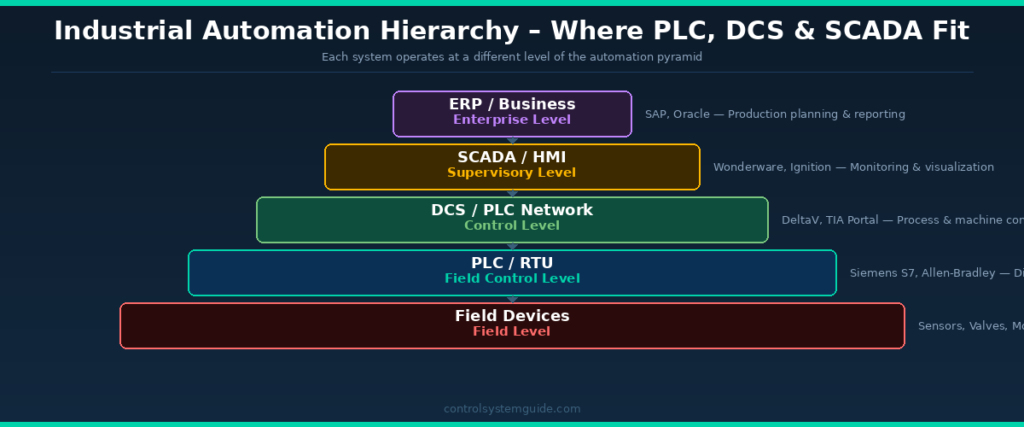
Understanding where PLC, DCS, and SCADA fit in the industrial automation hierarchy is essential. The ISA-95 automation pyramid defines five levels:
| Level | System | Function | Examples |
|---|---|---|---|
| Level 4 – Enterprise | ERP | Business planning, production scheduling | SAP, Oracle |
| Level 3 – Supervisory | SCADA / MES | Plant monitoring, data collection, reporting | Ignition, Wonderware |
| Level 2 – Control | DCS / PLC Network | Process control, coordination of controllers | DeltaV, TIA Portal |
| Level 1 – Field Control | PLC / RTU | Direct machine and process control | S7-1500, ControlLogix |
| Level 0 – Field | Field Devices | Physical process — sensors and actuators | Transmitters, motors, valves |
PLC vs DCS vs SCADA – Full Comparison Table
This complete PLC vs DCS vs SCADA guide covers everything you need to know:
| Feature | PLC | DCS | SCADA |
|---|---|---|---|
| Primary Function | Machine control | Process control | Monitoring & supervision |
| Control Type | Discrete (ON/OFF) | Continuous (analog) | Supervisory only |
| Architecture | Standalone controller | Distributed controllers + network | Software on PC/server |
| Response Speed | 1–20ms (very fast) | 100–500ms (moderate) | 1–5 seconds (supervisory) |
| Scale | Single machine or cell | Entire plant (thousands of I/O) | Multiple sites / large area |
| Redundancy | Optional | Built-in standard | Software redundancy |
| Programming | Ladder logic, FBD, ST | Function blocks, SFC | Graphical configuration |
| HMI/Visualization | Separate HMI needed | Built-in operator stations | Core function |
| Data Logging | Limited | Built-in historian | Full historical logging |
| Cost | Low ($500–$50,000) | Very high ($500K–$10M+) | Medium ($20K–$500K) |
| Vendor Lock-in | Low — mix brands | High — single vendor | Low — open protocols |
| Typical Industries | Manufacturing, packaging, automotive | Oil & gas, power, chemicals | Water, pipelines, utilities |
| Cybersecurity | Basic | Advanced (built-in) | Network-level security critical |
Where Each System Is Used – Real Industry Examples
PLC Applications
| Industry | Typical PLC Application | Why PLC? |
|---|---|---|
| Automotive | Robotic welding lines, press control | Fast discrete control, high speed |
| Food & Beverage | Filling machines, conveyor control | Cost-effective, flexible |
| Packaging | Wrapping, labelling, palletising | High-speed sequencing |
| Manufacturing | Assembly lines, CNC machine control | Reliable, easy to maintain |
| Water Treatment | Small pump stations | Simple, low cost |
DCS Applications
| Industry | Typical DCS Application | Why DCS? |
|---|---|---|
| Oil & Gas | Refinery process control, pipeline control | Redundancy, thousands of I/O |
| Power Generation | Boiler control, turbine management | Safety-critical, continuous process |
| Chemical Plants | Reactor temperature, batch control | Precise analog control |
| Pharmaceuticals | FDA-compliant batch manufacturing | Audit trails, validated software |
| Paper & Pulp | Continuous process control | Plant-wide coordination |
SCADA Applications
| Industry | Typical SCADA Application | Why SCADA? |
|---|---|---|
| Water & Wastewater | Municipal water distribution network | Geographically distributed sites |
| Oil & Gas | Pipeline monitoring over hundreds of km | Remote monitoring, data collection |
| Electrical Utilities | Power grid monitoring and control | Wide area, centralized supervision |
| Smart Manufacturing | Factory-wide OEE monitoring | Data analytics, KPI dashboards |
| Building Automation | Multi-site HVAC and energy monitoring | Remote access, reporting |
How PLC, DCS, and SCADA Work Together
In modern industrial plants, PLC, DCS, and SCADA are rarely used in isolation — they work together in a layered architecture. Here is a real example from a large manufacturing facility:
Example: Automotive Paint Shop
- PLCs (Level 1): Control individual machines — conveyors, robots, spray booths, ovens. Each machine has its own PLC running at 5–10ms scan speed.
- HMIs (Level 1–2): Local operator panels on each machine allow line operators to start, stop, and monitor individual equipment.
- SCADA (Level 3): A plant-wide Ignition SCADA system collects data from all PLCs via OPC-UA, displays real-time production status on large screens in the control room, manages alarms, and logs production data to a historian database.
- ERP (Level 4): SAP reads production counts from SCADA to update inventory, plan maintenance schedules, and generate production reports.
Example: Oil Refinery
- DCS (Level 1–2): An Emerson DeltaV DCS controls the entire refinery — thousands of temperature, pressure, flow, and level signals — from a central control room. Safety instrumented systems (SIS) are integrated.
- SCADA (Level 3): Pipeline SCADA monitors crude oil transfer from storage tanks to the refinery over long distances, providing remote visibility and alarm management.
- ERP (Level 4): Production data flows automatically from DCS to the business systems for yield reporting and crude oil inventory management.
PLC vs DCS vs SCADA – Decision Guide
Use this PLC vs DCS vs SCADA decision guide to choose the right system:
| Your Requirement | Best Choice | Reason |
|---|---|---|
| Control a single machine or production cell | PLC | Fast, cost-effective, flexible |
| Control an entire process plant (oil, chemical, power) | DCS | Plant-wide coordination, built-in redundancy |
| Monitor a geographically distributed system | SCADA | Remote monitoring, wide-area communication |
| Need visualization on the machine itself | HMI | Local operator interface, low cost |
| Budget is limited, small system | PLC + HMI | Most cost-effective combination |
| Need full redundancy and plant-wide integration | DCS | Built-in redundancy and historian |
| Need data logging and reporting across all machines | PLC + SCADA | SCADA adds data layer to PLCs |
| Continuous process with thousands of analog signals | DCS | Purpose-built for continuous control |
Frequently Asked Questions – PLC vs DCS vs SCADA
What is the main difference between PLC and DCS?
A PLC is designed for fast, discrete machine control — it controls individual machines with ON/OFF signals at millisecond speed. A DCS is designed for large-scale continuous process control — it coordinates thousands of analog signals across an entire plant with built-in redundancy and a unified operator interface. PLCs are cheaper and more flexible. DCS systems are more expensive but provide a complete integrated solution for large continuous processes.
Is SCADA a hardware or software system?
SCADA is primarily a software system. It runs on standard computers or servers and communicates with PLCs, RTUs, and DCS controllers through industrial protocols like OPC-UA, Modbus, and Ethernet/IP. SCADA does not directly control field devices — it relies on PLCs or other controllers to execute the actual control logic. SCADA provides monitoring, visualization, alarming, and data logging.
Can a PLC replace a DCS?
For small to medium-scale processes, a network of PLCs with a SCADA system can replace a DCS. However, for large continuous processes in oil and gas, power generation, or chemical plants, a DCS is generally preferred because it provides built-in redundancy, validated software, plant-wide integration, and an integrated historian — all from a single vendor. The engineering effort to replicate these features with PLCs and SCADA in large plants is usually greater than the cost of a DCS.
What is the difference between HMI and SCADA?
An HMI is a local operator panel — typically a touchscreen display mounted directly on a machine that shows the status of that specific machine and allows local control. SCADA is a plant-wide or site-wide supervisory system running on a PC or server in a control room. It monitors multiple machines and systems simultaneously, manages alarms across the plant, logs historical data, and can communicate with remote sites. An HMI covers one machine. SCADA covers an entire facility or multiple facilities.
Which system should a beginner learn first — PLC, DCS, or SCADA?
Beginners should always start with PLC programming. PLC programming teaches the fundamental concepts of industrial automation — inputs, outputs, control logic, timers, counters, and fault handling. These concepts transfer directly to DCS and SCADA. Once PLC programming is understood, SCADA is relatively easy to learn as it simply visualizes what the PLC is doing. DCS is typically learned last, especially for engineers entering the process industry.
What communication protocols do PLC, DCS, and SCADA use?
Common protocols include Modbus RTU and Modbus TCP (widely used with PLCs and SCADA), Ethernet/IP (Allen-Bradley standard), PROFIBUS and PROFINET (Siemens standard), OPC-UA (universal standard for PLC to SCADA communication), DNP3 (used in utilities and water treatment SCADA), and Foundation Fieldbus and HART (used in DCS for field instrument communication).
What is an RTU and how does it relate to SCADA?
An RTU (Remote Terminal Unit) is a field controller similar to a PLC but designed specifically for remote and geographically distributed sites with limited power and communication infrastructure. RTUs are commonly used in oil and gas pipelines, water distribution networks, and electrical utilities where they collect data from field instruments and transmit it back to the SCADA system via radio, cellular, or satellite communication.
How are PLC and DCS systems programmed differently?
PLCs are typically programmed using ladder logic, function block diagrams, or structured text in software like Siemens TIA Portal or Rockwell Studio 5000. DCS systems use proprietary configuration tools from the DCS vendor — for example, Emerson DeltaV Studio, Honeywell Engineering Station, or ABB Engineering Workplace. DCS configuration involves more pre-built function blocks for process control (PID loops, cascade control, ratio control) compared to PLC programming which requires more custom logic.
Conclusion
PLC vs DCS vs SCADA — these are not competing technologies— they are complementary systems that work together at different levels of industrial automation:
- PLC — controls individual machines and equipment at the field level. Fast, flexible, cost-effective.
- DCS — controls large-scale continuous processes across an entire plant. Integrated, redundant, expensive.
- SCADA — monitors and supervises the entire system from a central location. Software-based, wide-area visibility, data logging.
- HMI — provides local operator interface at the machine level. Simple, low-cost, specific to one machine.
Understanding where each system fits in the automation hierarchy helps you design better control systems, choose the right technology for each application, and build a stronger career in industrial automation.
Related Guides:
- SCADA vs DCS – Detailed Comparison
- Complete PLC Programming Guide – 23 Lessons
- PLC Inputs and Outputs – DI, DO, AI, AO Explained
- PLC Ladder Logic Tutorial – 7 Examples

Automation engineer based in Asia, with hands-on experience in PLC programming, SCADA, and industrial control systems across oil and gas, power, food and beverage, and water industries. Writes about PLC fundamentals, ladder logic, vendor-specific instruction sets for Siemens, Allen-Bradley, and other major platforms, and industrial communication protocols.