
Last Updated: April 2026 | Written for automation engineers, students and beginners entering industrial control systems.
SCADA and DCS are the two most important industrial control system architectures in the world — and they are frequently confused with each other. Both monitor industrial processes, both display data to operators, and both execute control logic. Yet they are fundamentally different in their design, architecture, geographic scope, and the industries they serve.
In this complete SCADA vs DCS guide you will learn:
- Clear definitions of SCADA and DCS — what each system actually is
- A full 15-point comparison table covering every key difference
- Which industries use SCADA and which use DCS — with real examples
- How architecture, response time, and redundancy differ between both
- Real brand examples — Wonderware, Ignition, Siemens PCS7, Emerson DeltaV
- How SCADA and DCS relate to PLCs, RTUs, and HMIs
- The growing trend of hybrid SCADA/DCS systems in 2026
For the complete three-way comparison including PLCs, read: PLC vs DCS vs SCADA – Full Comparison Guide
What Is SCADA?
SCADA (Supervisory Control and Data Acquisition) is an industrial control system architecture designed for wide-area monitoring and supervisory control of geographically distributed processes. SCADA systems collect data from remote field devices — PLCs, RTUs, and sensors — transmit that data over communication networks to a central control room, and allow operators to monitor and supervise the entire system from one location.
The key word in SCADA is supervisory. The SCADA system sits above the actual control layer — it monitors what is happening, raises alarms, and sends high-level commands, but the local PLCs and RTUs perform the actual real-time control logic.
| SCADA Component | Function | Examples |
|---|---|---|
| SCADA Server | Central data collection and processing hub | Wonderware System Platform, Ignition Server |
| HMI / Operator Station | Graphical interface for operator monitoring and control | WinCC, FactoryTalk View, Citect |
| PLC / RTU | Local field controllers that execute real-time logic | Siemens S7-1200, Allen-Bradley CompactLogix |
| Communication Network | Links remote field devices to SCADA server | Ethernet, 4G/5G, GPRS, satellite, radio |
| Historian | Long-term data storage for trending and reporting | OSIsoft PI, Wonderware Historian |
| Engineering Workstation | Configuration, programming and maintenance access | SCADA development PC |
Where Is SCADA Used?
SCADA is the system of choice when the controlled process is spread across a large geographic area — oil and gas pipelines spanning thousands of kilometres, national power transmission grids, water distribution networks serving entire cities, and transportation infrastructure. The defining characteristic is distance — SCADA works where it is physically impossible to have a single control system directly connected to all field devices.
What Is DCS?
DCS (Distributed Control System) is an industrial control system architecture designed for integrated, real-time process control within a single plant or facility. Unlike SCADA which supervises remote PLCs, a DCS contains its own distributed controllers positioned close to the process — and these controllers execute all control loops directly, with the operator station connected to the same integrated network.
The key word in DCS is distributed — the control intelligence is distributed throughout the plant in dedicated process controllers, but all controllers share a common integrated network, database, and engineering environment from a single vendor.
| DCS Component | Function | Examples |
|---|---|---|
| Process Controllers | Distributed controllers executing real-time control loops | Siemens PCS7 AS, Honeywell C300 |
| Operator Station | Integrated graphical interface — part of DCS system | PCS7 OS, DeltaV Operate |
| Engineering Station | Single unified environment for all DCS configuration | PCS7 Engineering, DeltaV Explorer |
| Plant Bus / Control Network | High-speed deterministic network linking all DCS components | PROFIBUS, PROFINET, Foundation Fieldbus |
| Historian / OPC Server | Integrated data storage — often part of DCS package | PCS7 Historian, DeltaV Continuous Historian |
| Redundancy | Hot-standby controllers and networks — built-in standard | Dual CPU, dual network, dual IO modules |
Where Is DCS Used?
DCS is the system of choice for complex continuous process industries on a single site — chemical plants, oil refineries, pharmaceutical manufacturing, power generation plants, and pulp and paper mills. These industries require deterministic real-time control of hundreds or thousands of interdependent control loops where process uptime is critical and a control system failure could cause dangerous or costly process upsets.
SCADA vs DCS – Complete Comparison Table
| Feature | SCADA | DCS |
|---|---|---|
| Full name | Supervisory Control and Data Acquisition | Distributed Control System |
| Primary purpose | Monitoring and supervisory control | Real-time integrated process control |
| Geographic scope | Wide area — hundreds or thousands of km | Single site — one plant or facility |
| Architecture | Centralized server — remote PLCs/RTUs report in | Distributed controllers throughout plant |
| Control execution | PLCs/RTUs execute local control — SCADA supervises | DCS controllers execute all control loops directly |
| Response time | Seconds — supervisory level | Milliseconds — real-time closed-loop |
| Redundancy | Optional — varies by implementation | Built-in standard — 99.9%+ uptime |
| Integration | Multi-vendor — PLCs from any manufacturer | Single-vendor — fully integrated system |
| Communication | OPC, Modbus, DNP3, 4G/5G, satellite | PROFIBUS, PROFINET, Foundation Fieldbus (proprietary) |
| Engineering environment | Separate tools for PLC + HMI + SCADA | Single unified engineering environment |
| Scalability | Highly scalable — add PLCs/RTUs easily | Less flexible — adding controllers more complex |
| Upfront cost | Lower — standard hardware and software | Higher — proprietary integrated system |
| Field I/O | Indirect — through PLCs and RTUs | Direct — DCS IO modules connect to field directly |
| Safety integration | Separate safety PLC system required | Integrated safety controllers available |
| Typical tag count | Hundreds to thousands of tags | Thousands to hundreds of thousands of tags |
SCADA vs DCS – Architecture Comparison
SCADA Architecture
A SCADA system is built around a central SCADA server that acts as the data hub. Remote field devices — PLCs, RTUs, and sensors — are distributed across large distances and communicate with the central server using various communication protocols over WAN networks including Ethernet, 4G/5G cellular, GPRS, radio, and even satellite links.
The architecture is star-shaped — all remote devices report to the central server. The SCADA server then provides data to operator workstations and HMIs. The critical point is that real-time control is performed locally by the PLCs and RTUs — if communication to the SCADA server is lost, the PLCs continue executing their control programs independently. SCADA only provides supervisory visibility.
DCS Architecture
A DCS is built around a high-speed plant bus — a dedicated deterministic communication network that connects all DCS components: process controllers, IO modules, operator stations, and engineering workstations. All components are from the same vendor and are designed to work together as a single integrated system.
The architecture is distributed but tightly integrated — process controllers are physically located close to the process equipment they control, reducing signal wiring lengths and improving response time. All controllers share the same tag database, alarm management system, and historian — there is no separation between the control layer and the supervisory layer as there is in SCADA.
SCADA vs DCS – Industry Applications
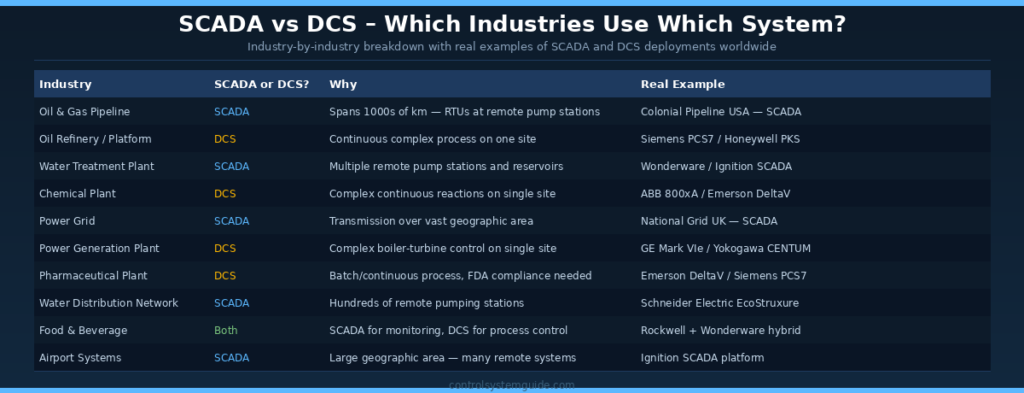
| Industry | SCADA or DCS? | Reason |
|---|---|---|
| Oil and gas pipeline | SCADA | Spans thousands of km — RTUs at remote pump and compressor stations |
| Oil refinery / platform | DCS | Complex continuous process on single site — tight integration required |
| Water treatment plant | SCADA | Multiple remote pump stations and reservoirs across large area |
| Chemical plant | DCS | Complex continuous reactions on single site — millisecond control required |
| Power transmission grid | SCADA | National grid spans entire country — thousands of remote substations |
| Power generation plant | DCS | Complex boiler-turbine control on single site — redundancy critical |
| Pharmaceutical plant | DCS | Batch/continuous process — FDA 21 CFR Part 11 compliance required |
| Water distribution network | SCADA | Hundreds of remote pumping stations spread across city |
| Food and beverage | Both | SCADA for multi-site monitoring, DCS or PLC for plant process control |
| Airport systems | SCADA | Large geographic area — many independent building and runway systems |
Real Brand Examples – SCADA vs DCS Systems
Leading SCADA Software Platforms
| SCADA Platform | Vendor | Strengths | Typical Industries |
|---|---|---|---|
| Ignition | Inductive Automation | Web-based, unlimited tags, free development mode | Manufacturing, water, food |
| Wonderware (AVEVA) | AVEVA | Industry leader, powerful historian, large install base | Oil and gas, utilities, manufacturing |
| WinCC OA | Siemens | Scalable, redundant, open architecture | Infrastructure, utilities, airports |
| Citect SCADA | AVEVA | Strong in mining and utilities | Mining, metals, power distribution |
| FactoryTalk View SE | Rockwell Automation | Tight Allen-Bradley integration | Manufacturing, food and beverage |
Leading DCS Platforms
| DCS Platform | Vendor | Strengths | Typical Industries |
|---|---|---|---|
| SIMATIC PCS7 | Siemens | Integrates with S7 PLCs, TIA Portal engineering | Chemical, pharma, food, power |
| DeltaV | Emerson | Best-in-class for pharmaceutical — FDA compliance | Pharma, biotech, oil and gas |
| System 800xA | ABB | Scalable, strong in power generation | Power, pulp and paper, mining |
| Experion PKS | Honeywell | Strong in refining and LNG | Oil refining, LNG, petrochemical |
| CENTUM VP | Yokogawa | Excellent in Asia-Pacific region | Chemical, oil and gas, pharma |
SCADA vs DCS – Response Time and Control Performance
Response time is one of the most critical technical differences between SCADA and DCS systems.
| Parameter | SCADA | DCS |
|---|---|---|
| Control loop update rate | Seconds (supervisory only) | 100-500ms (real-time closed-loop) |
| Scan cycle | Depends on PLC scan (1-20ms) — SCADA polling is slower | Deterministic — 100ms typical for PID loops |
| Alarm response | SCADA detects alarm after next polling cycle | Alarm detected immediately by process controller |
| Data update to operator | 1-5 second refresh typical | Sub-second — integrated system |
| Network determinism | Not guaranteed — uses standard Ethernet/WAN | Guaranteed — dedicated deterministic plant bus |
💡 Key Insight: For a water pipeline pump station that needs to maintain pressure within a wide band — SCADA response time is perfectly adequate. For a pharmaceutical reactor where temperature must be controlled within 0.5°C in real time — only DCS with millisecond response time is acceptable.
SCADA vs DCS – Redundancy and Reliability
Redundancy requirements differ significantly between SCADA and DCS:
| Redundancy Type | SCADA | DCS |
|---|---|---|
| Server redundancy | Optional — hot-standby SCADA server available | Standard — redundant operator servers built-in |
| Controller redundancy | PLC redundancy separate and optional | Standard — redundant process controllers built-in |
| Network redundancy | Varies — WAN links may be single or redundant | Standard — dual redundant plant bus standard |
| IO redundancy | Not standard | Available — redundant IO modules for critical signals |
| Bumpless transfer | Manual transfer on failure | Automatic — sub-second bumpless transfer |
| Typical uptime | 99.5-99.9% achievable | 99.9-99.999% — designed for zero downtime |
The Growing Convergence – Hybrid SCADA/DCS Systems
In 2026, the traditional boundary between SCADA and DCS is blurring. Modern industrial facilities increasingly deploy hybrid architectures that combine the geographic flexibility of SCADA with the process control power of DCS:
- DCS for core plant control — all continuous process loops executed by DCS controllers with full redundancy
- SCADA for multi-site oversight — SCADA layer provides supervisory visibility across multiple DCS plants from one control room
- OPC-UA as the bridge — modern DCS systems publish data via OPC-UA, allowing SCADA and MES systems to consume DCS data without proprietary connections
- Cloud integration — both SCADA and DCS vendors now offer cloud connectivity for analytics, digital twins, and predictive maintenance
According to the International Society of Automation (ISA), the integration of OT (Operational Technology) and IT (Information Technology) is driving a convergence where the distinction between SCADA and DCS is becoming less important than the overall system architecture.
SCADA vs DCS – Which Should You Choose?
| Choose SCADA if… | Choose DCS if… |
|---|---|
| Your process spans a large geographic area | Your process is on a single site or facility |
| You need to monitor hundreds of remote sites | You need real-time closed-loop process control |
| Communication interruptions are tolerable | Process uptime is critical — no interruptions acceptable |
| You already have PLCs from multiple vendors | You want a single-vendor integrated system |
| Budget is constrained — standard hardware required | Maximum reliability justifies higher cost |
| System will grow and change over time | Process is continuous and stable — minimal changes |
| Industry: utilities, pipelines, water, transport | Industry: chemical, pharma, refining, power generation |
How SCADA and DCS Relate to PLCs
Understanding the relationship between SCADA, DCS, and PLCs is essential for anyone learning industrial automation:
| System | Role | Level | Executes Control? |
|---|---|---|---|
| PLC | Machine/process controller — executes ladder logic | Field level (Level 1) | ✅ Yes — directly |
| SCADA | Supervisory monitoring — sits above PLCs | Supervisory level (Level 2-3) | ⚠️ Supervisory only |
| DCS | Integrated plant control — replaces PLCs in process plants | Field + supervisory (Level 1-3) | ✅ Yes — directly |
| MES | Manufacturing execution — production planning and tracking | Plant level (Level 3-4) | ❌ No — data only |
| ERP | Business systems — SAP, Oracle | Enterprise (Level 4-5) | ❌ No — business data |
For a complete three-way comparison: PLC vs DCS vs SCADA – Full Comparison, Architecture and Decision Guide
Frequently Asked Questions – SCADA vs DCS
What is the main difference between SCADA and DCS?
The main difference is scope and control level. SCADA (Supervisory Control and Data Acquisition) is designed for wide-area monitoring and supervisory control of geographically distributed processes — real control is performed by local PLCs and RTUs. DCS (Distributed Control System) is designed for integrated real-time process control within a single plant — the DCS controllers themselves execute all control loops directly. SCADA monitors from above while DCS controls from within.
Is DCS better than SCADA?
Neither is universally better — they serve different purposes. DCS is better for continuous process industries on a single site where real-time control, redundancy, and process integration are critical — such as chemical plants, refineries, and pharmaceutical manufacturing. SCADA is better for geographically distributed systems where remote monitoring over large areas is required — such as pipelines, power grids, and water distribution networks. The right choice depends entirely on the application.
Can SCADA and DCS be used together?
Yes — and this is increasingly common in 2026. A typical large industrial operation might use a DCS for real-time process control within a plant, and a SCADA system at a higher level to provide supervisory visibility across multiple plants or remote sites. OPC-UA is the standard protocol used to connect DCS systems to SCADA layers without proprietary integration requirements.
What industries use DCS?
DCS is predominantly used in continuous process industries on single sites including chemical manufacturing, oil refining, pharmaceutical production, power generation plants (gas turbines, nuclear), pulp and paper mills, and food and beverage processing. These industries require deterministic real-time control, high reliability, and integrated process management that only a DCS provides.
What industries use SCADA?
SCADA is predominantly used in geographically distributed infrastructure including oil and gas pipelines, national power transmission grids, water treatment and distribution networks, wastewater management systems, transportation infrastructure (railways, airports), and any application where remote sites must be monitored and controlled from a central location over large distances.
What is the response time difference between SCADA and DCS?
DCS provides deterministic response times measured in milliseconds — typically 100-500ms for PID control loops — making it suitable for tight real-time process control. SCADA operates at supervisory level with response times measured in seconds — it polls field devices periodically and updates operator displays accordingly. For applications requiring precise real-time control like temperature regulation in a chemical reactor DCS is essential. For supervisory monitoring of a pipeline DCS response time is unnecessary.
Which is more expensive — SCADA or DCS?
DCS systems are significantly more expensive upfront because they are integrated single-vendor systems with proprietary hardware, software licenses, and engineering tools. A large DCS installation can cost millions of dollars. SCADA systems use standard hardware — commercial PCs, standard networking equipment, and multi-vendor PLCs — making them considerably less expensive to implement. However for complex process industries the reliability and integration benefits of DCS justify the higher cost.
What is the difference between RTU and PLC in SCADA?
An RTU (Remote Terminal Unit) is a field device specifically designed for harsh remote environments — extreme temperatures, limited power, and unreliable communications. RTUs are typically used in oil and gas pipelines, power substations, and water infrastructure where they must operate reliably without local maintenance for months. PLCs are more commonly used in SCADA systems where environmental conditions are less extreme and faster scan times are needed. Modern PLCs with IEC 61131-3 programming have largely replaced traditional RTUs in many SCADA applications.
Conclusion
SCADA and DCS are both essential industrial control system architectures — but they serve fundamentally different roles in the automation hierarchy.
Use this simple decision guide:
- Large geographic area? → SCADA — pipelines, grids, water networks
- Single site, complex process? → DCS — chemical, pharma, refining
- Supervisory monitoring needed? → SCADA above PLCs or DCS
- Real-time closed-loop control critical? → DCS every time
- Multi-vendor flexibility needed? → SCADA with standard PLCs
- Maximum reliability and uptime? → DCS with built-in redundancy
Related Guides:
- PLC vs DCS vs SCADA – Full Three-Way Comparison
- What Is a PLC? Complete Beginner’s Guide
- PLC Inputs and Outputs – DI, DO, AI, AO Complete Guide
- 4-20mA Signal Explained – Complete Industrial Guide

Automation engineer based in Asia, with hands-on experience in PLC programming, SCADA, and industrial control systems across oil and gas, power, food and beverage, and water industries. Writes about PLC fundamentals, ladder logic, vendor-specific instruction sets for Siemens, Allen-Bradley, and other major platforms, and industrial communication protocols.