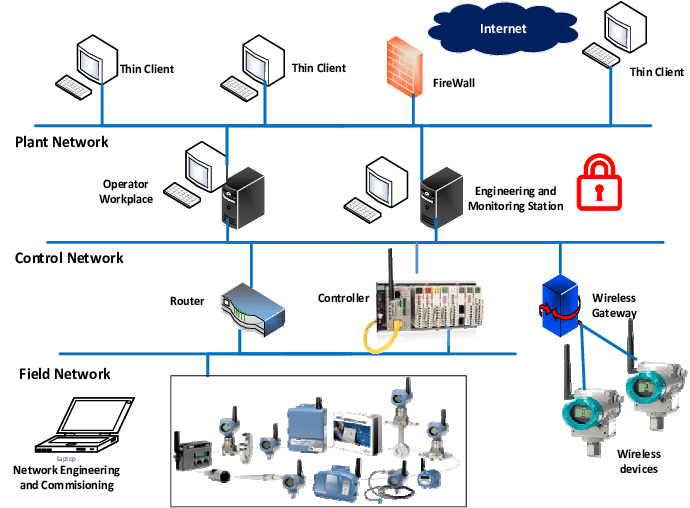
PLC, DCS, and SCADA are three of the most commonly used control systems in industrial automation, but beginners often get confused about how they differ. Although these systems are sometimes used together, they serve different purposes in industrial environments.
This article explains the key differences between PLC, DCS, and SCADA in simple terms. By the end, you’ll understand where each system is used, how they work together, and which one is suitable for different industrial applications.
What Is a PLC?
A PLC, or Programmable Logic Controller, is an industrial computer designed to control machines and automated processes. It reads input signals from field devices such as sensors and switches, executes control logic based on a program, and controls outputs like motors, valves, and actuators.
PLCs are widely used for fast, reliable, and discrete control tasks. They are built to operate continuously in harsh industrial environments and are commonly found in manufacturing lines, machinery control, and standalone automation systems.
What Is a DCS?
DCS stands for Distributed Control System. A DCS is designed to control large and complex industrial processes by distributing control functions across multiple controllers connected through a communication network.
DCS systems are commonly used in process industries such as oil and gas, power generation, chemical plants, and refineries. They are well suited for continuous processes, where precise regulation, redundancy, and system-wide coordination are critical.
What Is SCADA?
SCADA stands for Supervisory Control and Data Acquisition. Unlike PLCs and DCS, SCADA is primarily a software-based system used for monitoring, supervision, and data collection rather than direct control.
SCADA systems gather data from PLCs, DCS controllers, and remote devices, then display this information through graphical interfaces. Operators use SCADA to monitor system status, view alarms, and make high-level control decisions across large or geographically distributed systems.
Key Differences Between PLC, DCS, and SCADA
PLC, DCS, and SCADA differ mainly in their purpose, architecture, and scale of application. PLCs are designed for fast, localized control of machines and equipment, while DCS systems are intended for large-scale, continuous process control with distributed controllers.
SCADA systems, on the other hand, focus on supervision and monitoring rather than direct control. They collect data from PLCs and DCS controllers and present it to operators through graphical interfaces for monitoring, alarming, and reporting.
In simple terms, PLCs perform the control actions, DCS coordinates complex process control across multiple areas, and SCADA provides visibility and high-level supervision of the entire system.
Where PLC, DCS, and SCADA Are Used
PLCs are commonly used in manufacturing plants, packaging lines, conveyors, and standalone machinery where fast and reliable control is required. They are ideal for discrete automation tasks and machine-level control.
DCS systems are widely used in industries such as oil and gas, power generation, chemical processing, and refineries, where large-scale continuous processes require centralized monitoring and distributed control.
SCADA systems are typically used for monitoring and controlling geographically distributed systems such as water distribution networks, pipelines, electrical grids, and remote pumping stations.
How PLC, DCS, and SCADA Work Together
In modern industrial automation systems, PLC, DCS, and SCADA are often used together rather than separately. PLCs and DCS controllers handle the real-time control of machines and processes at the field level.
SCADA systems sit on top of these controllers and provide operators with a centralized view of the entire system. They collect data, display process graphics, generate alarms, and allow operators to monitor performance and respond to issues.
This layered approach allows industries to achieve reliable control, centralized monitoring, and efficient decision-making across complex automation systems.
Which One Should You Learn First?
For beginners entering industrial automation, learning PLCs first is usually the best choice. PLC programming teaches fundamental control concepts such as inputs, outputs, logic execution, and troubleshooting, which are essential for understanding automation systems.
Once PLC fundamentals are mastered, learning SCADA becomes much easier, as SCADA systems rely heavily on data provided by PLCs. DCS systems are typically learned later, especially by engineers working in process industries.
Starting with PLCs provides a strong foundation that makes it easier to transition to SCADA and DCS systems as your experience grows.
Final Comparison Summary
PLC, DCS, and SCADA each serve distinct roles in industrial automation. PLCs focus on fast and reliable machine-level control, DCS systems manage large-scale continuous processes, and SCADA provides supervisory monitoring and data visualization.
Understanding the differences between these systems helps beginners choose the right learning path and enables engineers to design effective automation solutions. In most industrial environments, these technologies work together to deliver safe, efficient, and reliable control systems.