PLC programming is the backbone of modern industrial automation. From simple motor control systems to complex manufacturing plants, it enables machines, processes, and production lines to operate safely, efficiently, and automatically.
This complete guide is designed for beginners, students, technicians, and automation engineers who want a clear, structured, and practical understanding of PLC controls programming—from fundamentals to advanced industrial applications.
What Is PLC Programming?
PLC programming is the process of writing control logic for a Programmable Logic Controller (PLC) to automate machines and industrial processes.
A PLC is a rugged industrial computer designed to:
- Continuously monitor input signals
- Execute programmed logic in real time
- Control output devices such as motors, valves, and actuators
Unlike traditional computers, PLCs are optimized for deterministic control, meaning they respond predictably and reliably under harsh industrial conditions.
It replaced relay-based control systems, offering higher flexibility, faster troubleshooting, and easier scalability.
Why It Is Essential in Industry
PLC automation programming is used in nearly every industrial sector because it provides:
- High reliability in harsh environments
- Real-time control and decision-making
- Reduced wiring and hardware complexity
- Easy modification without physical rewiring
- Integration with SCADA, HMI, and DCS systems
Industries relying on industrial automation programming include:
- Manufacturing and assembly lines
- Oil and gas plants
- Power generation and substations
- Water and wastewater treatment
- Automotive production
- Food and beverage processing
How Engineers Actually Decide to Use PLC
In real industrial projects, PLC is not selected because it is popular.
Engineers choose it after evaluating the process requirements.
Typical decision factors:
- Number of inputs and outputs
- Required response speed
- Safety requirements
- Communication with other systems (SCADA, drives, instruments)
- Future expansion
- Budget constraints
Example:
A small machine with 25 IO → compact PLC
A chemical plant with redundancy → modular PLC or DCS
How It Works (PLC Scan Cycle)
PLC systems programming operate using a repetitive loop called the PLC Scan Cycle.
PLC Scan Cycle Steps
- Input Scan – Reads the status of all input devices
- Program Execution – Executes the PLC program logic line by line
- Output Scan – Updates output devices based on logic results
- Housekeeping – Diagnostics, communication, and internal checks
This cycle repeats continuously, typically within milliseconds, ensuring real-time industrial control.
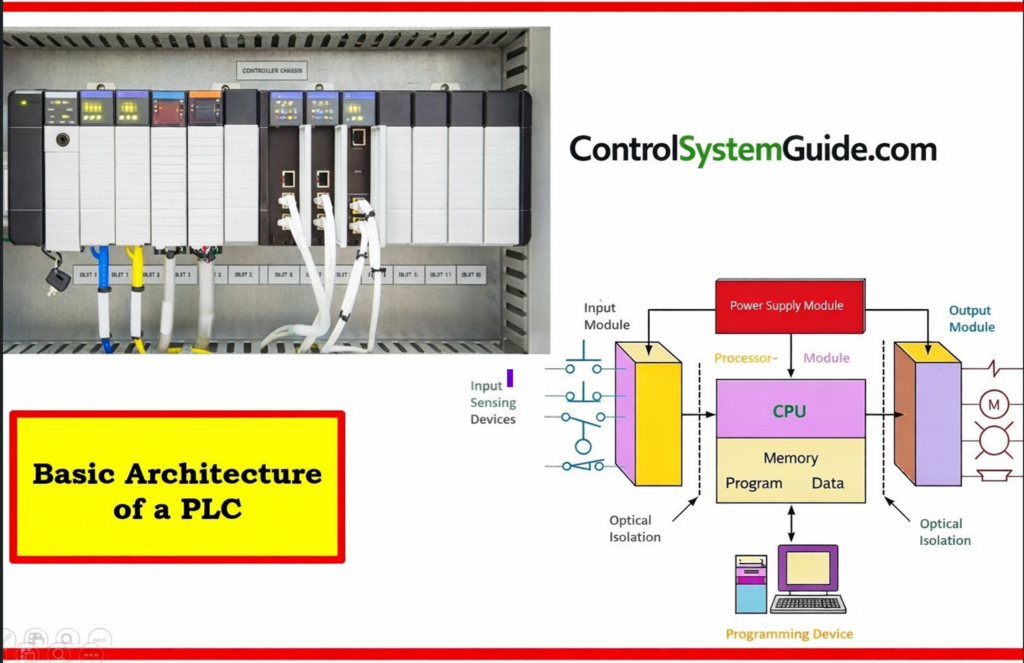
PLC Hardware Architecture
A PLC system consists of modular hardware components:
Central Processing Unit (CPU)
- Executes the PLC program
- Manages memory and logic operations
Power Supply
- Converts industrial power to PLC-compatible voltage
Input Modules
- Digital inputs (push buttons, switches)
- Analog inputs (temperature, pressure, flow)
Output Modules
- Digital outputs (motors, relays)
- Analog outputs (valve positioning, speed control)
Communication Modules
- Enable networking and protocol communication
PLC Inputs and Outputs (I/O Explained)
Digital Inputs
- ON/OFF signals
- Examples: push buttons, limit switches
Digital Outputs
- Control ON/OFF devices
- Examples: motors, contactors
Analog Inputs
- Continuous signals (0–10V, 4–20mA)
- Examples: temperature, pressure sensors
Analog Outputs
- Control proportional devices
- Examples: control valves, VFD speed
Understanding I/O mapping is critical for correct implementation.
Example: Selecting PLC for a Small Factory
Suppose we need to automate a water pumping station:
Inputs:
8 level switches
2 pressure transmitters
4 push buttons
Outputs:
3 pumps
3 alarms
2 motorized valves
Total IO ≈ 22–28 points
An engineer would typically select:
Compact PLC with 30–40 IO capacity and Ethernet communication.
This is how PLC is chosen in practice — not only by theory.
Free PLC Selection & IO Estimation Checklist
In real projects, engineers rarely calculate PLC size manually every time.
To make this faster, I created a practical PLC selection and IO estimation checklist.
This sheet helps you quickly determine:
- Required PLC size
- Spare capacity
- Expansion margin
- Recommended module type
You can download it and reuse it for your own machines, plants, or final year projects.
Need Automatic Calculation Instead of Manual Estimation?
Many engineers asked if there is a faster way than manually estimating IO and panel power each time.
So I created a reusable calculator that automatically:
- Calculates total IO
- Suggests PLC size
- Estimates spare capacity
- Calculates panel power requirement
You can reuse it for every future project instead of repeating calculations.
PLC Programming Languages (IEC 61131-3)
programmable controller programming are standardized under IEC 61131-3.
Main PLC Programming Languages
- Ladder Logic (LD) – Most popular, relay-style logic
- Function Block Diagram (FBD) – Graphical block-based logic
- Structured Text (ST) – High-level, code-based language
- Sequential Function Chart (SFC) – Step-based sequencing
Ladder Logic remains the industry standard for PLC application due to its simplicity and maintainability.
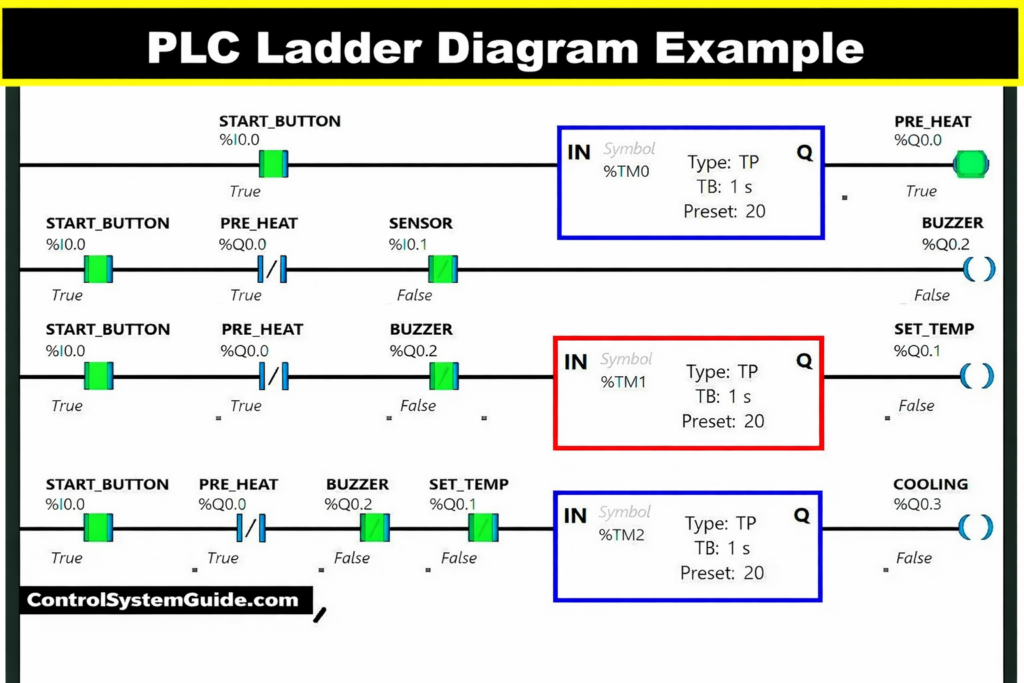
PLC Programming Example: Motor Control
A basic PLC application programming example is a motor start/stop circuit.
Logic Concept
- Start button → Motor ON
- Stop button → Motor OFF
- Latching logic → Motor stays ON after release
This example demonstrates:
- Digital inputs
- Output control
- Memory latching
PLC control programming examples like this form the foundation of industrial automation.
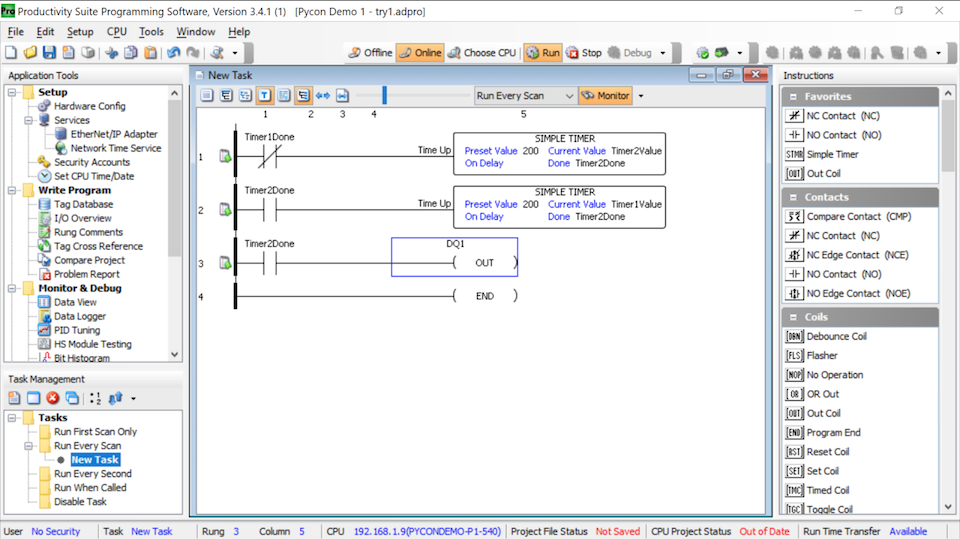
PLC Software Used for Programming
PLC programming software varies by manufacturer:
- Siemens – TIA Portal
- Allen-Bradley – Studio 5000
- Schneider – EcoStruxure Control Expert
- Mitsubishi – GX Works
- Free PLC simulators for learning
PLC Communication and Networking
PLC Systems programming often includes communication logic using protocols such as:
- Modbus (RTU / TCP)
- Profibus
- Profinet
- EtherNet/IP
PLC communication enables integration with:
- HMIs
- SCADA systems
- Industrial networks
- Cloud platforms
PLC vs SCADA vs DCS
- PLC Programming → Machine-level control
- SCADA → Monitoring and supervisory control
- DCS → Large-scale process control
Programmable Controller programming acts as the core control layer in automation systems.
Working on a Real Automation Project?
Selecting the wrong PLC can cause communication failure, insufficient IO, or costly redesign later.
If you want, you can send your application details and I will suggest:
- Suitable PLC model
- Required modules
- Communication architecture
- Future expansion margin
This is helpful for:
- Industrial plant automation
- Machine builders
- University projects
- System upgrades or migrations
Industrial Applications of PLC Programming
Programmable Controller programming is used in:
- Conveyor systems
- Packaging machines
- Boiler control
- Pump automation
- Robotic cells
- Process plants
PLC Programming Career and Salary
Programmable Controller programming offers strong career prospects.
Job Roles
- PLC Programmer
- Automation Engineer
- Control Systems Engineer
Skills Required
- PLC Systems programming
- Industrial networking
- Electrical fundamentals
- Troubleshooting
PLC programmers are in high demand worldwide.
How to Learn PLC Programming (Step-by-Step)
- Learn basic electrical concepts
- Understand PLC hardware
- Practice Ladder Logic
- Use PLC simulators
- Build real-world projects
Consistency matters more than complexity.
Frequently Asked Questions (FAQs)
Is PLC programming hard to learn?
No. PLC programming is beginner-friendly with structured practice.
Can I learn PLC programming without hardware?
Yes, using PLC simulation software.
Which PLC brand should beginners start with?
Siemens and Allen-Bradley are industry-leading choices.
Advanced PLC Programming Concepts (Industrial-Grade Control)
As PLC systems programming skills mature, engineers move beyond basic logic into advanced control strategies used in large-scale and safety-critical systems.
Redundancy in PLC Programming
Redundant PLC systems are designed to eliminate single points of failure.
Common redundancy types:
- CPU redundancy – backup processor takes over automatically
- Power supply redundancy – uninterrupted operation during power faults
- Network redundancy – ring or dual-network architectures
Redundant PLC systems programming is widely used in power plants, oil & gas facilities, and mission-critical manufacturing.
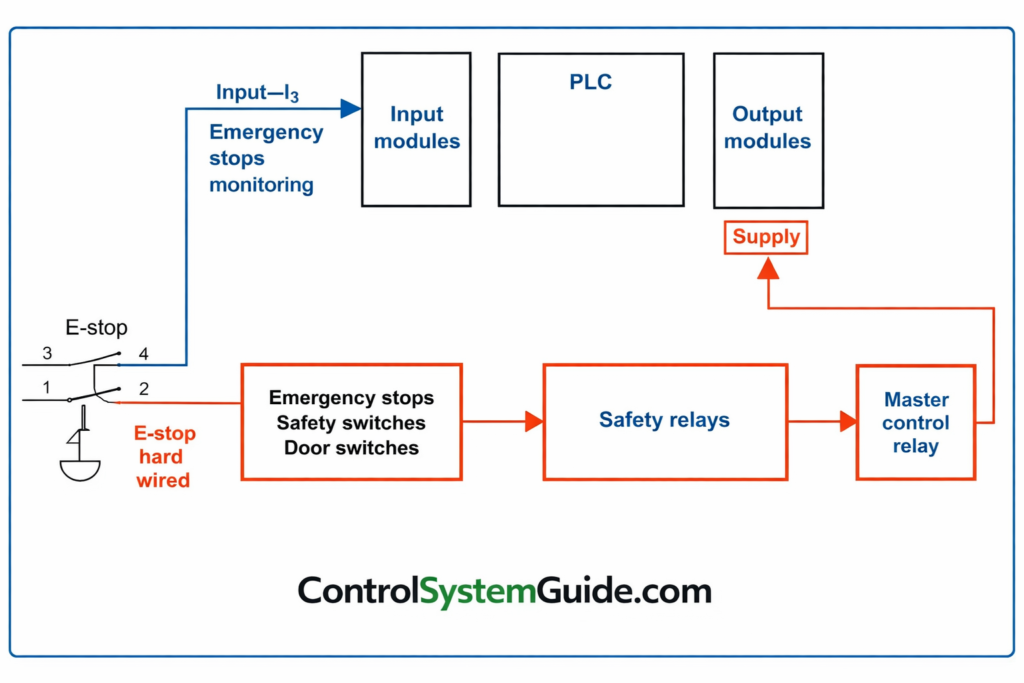
Safety PLC Programming (Functional Safety)
Safety Programmable Controller programming is used where human life and equipment protection are critical.
Key characteristics:
- Certified safety CPUs
- Failsafe inputs and outputs
- SIL (Safety Integrity Level) compliance
- Deterministic shutdown logic
Typical safety PLC applications:
- Emergency stop circuits
- Light curtains
- Safety doors
- Burner management systems
PLC Programming for Process Control
Programmable Controller programming is not limited to discrete automation. It also supports continuous and batch processes.
Common Process Control Applications
- Temperature control
- Pressure regulation
- Flow control
- Level control
PID Control in PLC Programming
Most PLC platforms support PID (Proportional–Integral–Derivative) control blocks.
PID logic enables:
- Stable process behavior
- Reduced oscillations
- Improved product quality
PLC programming with PID control is common in chemical plants, water treatment, and power generation.
PLC Programming in Industry 4.0
Modern Programmable Controller programming integrates with digital technologies.
Industry 4.0 Features
- IIoT connectivity
- Cloud data exchange
- Predictive maintenance
- Smart diagnostics
Industrial Automation programming now includes:
- Data tagging
- OPC UA communication
- Edge computing integration
Real Industrial Use Cases of PLC Programming
Manufacturing Industry
- Assembly line automation
- Robotic work cells
- Quality inspection systems
Oil and Gas Industry
- Pump control
- Compressor automation
- Safety shutdown systems
Power Industry
- Generator control
- Substation automation
- Load management
Water and Wastewater Industry
- Pump sequencing
- Level control
- Chemical dosing
Industrial Automation programming ensures safe, reliable, and efficient industrial operations.
How to Master PLC Programming (Practical Roadmap)
Phase 1 – Fundamentals
- Electrical basics
- Digital logic
- PLC hardware overview
Phase 2 – Core PLC Programming
- Ladder Logic mastery
- Timers and counters
- I/O mapping
Phase 3 – Industrial Skills
- PLC communication
- HMI integration
- Fault diagnostics
Phase 4 – Advanced Automation
- Safety PLCs
- PID control
- Redundant systems
This roadmap mirrors how Programmable Controller programming is used in real industry.
Common PLC Programming Mistakes (and How to Avoid Them)
- Poor I/O documentation
- No fault handling logic
- Hardcoded values instead of parameters
- Ignoring scan time impact
- No version control
Professional Industrial Automation programming emphasizes clarity, diagnostics, and maintainability.
PLC Programming Best Practices
- Use descriptive tag names
- Modularize logic using function blocks
- Comment programs clearly
- Implement alarm handling
- Test logic using simulators before deployment
These practices separate amateur PLC programmers from professionals.
Internal Learning Path (Recommended)
To deepen PLC programming mastery, continue with:
- PLC Inputs and Outputs Explained
- PLC Programming Languages Guide
- PLC vs SCADA vs DCS Comparison
- Best PLC Software for Beginners
- SCADA vs DCS – Differences, Architecture, and Applications
Practical Engineering Support
Many engineers understand PLC theory but struggle during real selection.
If you want, I can review your application and recommend:
- PLC model
- Required modules
- Communication architecture
This avoids costly design mistakes.
Why Correct PLC Selection Matters in Industry
In industry, choosing a PLC is not just about running a program.
An undersized PLC may fail during plant expansion.
A wrong communication protocol can stop production.
A non-standard platform increases maintenance cost.
Many real projects require redesign only because hardware was selected based on theory instead of application requirements.
This guide is written to prevent those mistakes.
How to Select PLC for a Real Project (Engineer Method)
In real industrial projects, PLC selection is not decided from theory or brand preference.
Automation engineers normally follow a structured workflow:
1) List all field devices (sensors, valves, motors, transmitters)
2) Count digital and analog signals
3) Add 20–30% spare capacity for expansion
4) Check control panel power loading
5) Choose PLC category based on total IO
Incorrect estimation usually causes either:
- undersized hardware (future modification required)
- oversized hardware (unnecessary cost)
For this reason, engineers rarely calculate manually each time and instead use reusable estimation tools.
This approach is commonly used in conveyor systems, water treatment plants, small process skids, and machine automation panels.
Final Authority Conclusion
PLC programming is not just a technical skill—it is a foundational discipline of industrial automation. From simple machine control to enterprise-level automation systems, PLC systems programming enables industries to operate safely, efficiently, and intelligently.
Mastering PLC Systems programming positions you at the core of modern industry, where reliability, logic, and real-world impact matter most.