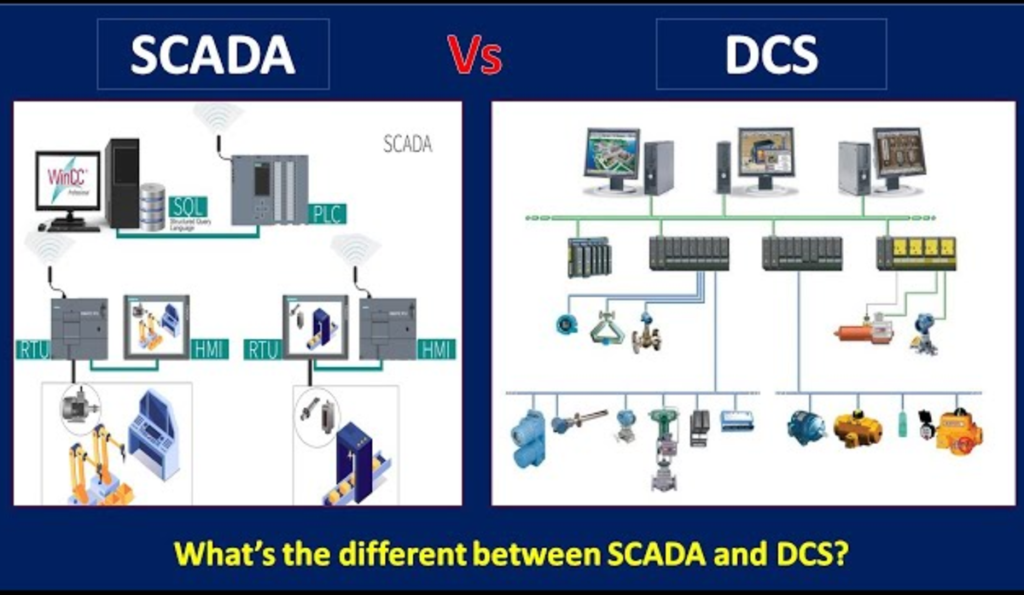
SCADA and DCS are two major systems used in industrial automation for monitoring, control, and process management. Although they are often used in similar industrial environments, their architecture, functionality, and applications are different.
Understanding the differences between SCADA and DCS is important for engineers, technicians, and automation professionals. In this guide, we will explain how SCADA and DCS work, compare their architectures, and explore real-world applications in industrial automation.
What Is SCADA?
SCADA (Supervisory Control and Data Acquisition) is a system used to monitor and control industrial processes over large geographical areas. It collects real-time data from sensors, PLCs, and remote devices and presents it to operators through graphical interfaces.
SCADA systems are commonly used in industries such as power distribution, water treatment, oil and gas pipelines, and transportation networks. They are designed to supervise processes rather than directly control every component at the field level.
What Is DCS?
DCS (Distributed Control System) is a control system used to manage complex industrial processes within a localized facility. Unlike SCADA, DCS is typically deployed within a single plant or production site and provides direct control over process equipment.
DCS systems are widely used in industries such as chemical processing, refineries, power plants, and manufacturing facilities. They offer high reliability, redundancy, and real-time control capabilities for continuous process operations.
Architecture of SCADA Systems
The architecture of a SCADA system typically consists of several layers, including field devices, communication networks, control units, and supervisory software. Field devices such as sensors and PLCs collect data, which is transmitted to central SCADA servers through communication protocols.
At the supervisory level, SCADA software provides visualization, alarm management, data logging, and reporting functions. This layered architecture allows SCADA systems to monitor distributed processes efficiently across wide areas.
Architecture of DCS Systems
The architecture of a DCS system is designed to control complex industrial processes within a plant using distributed controllers and centralized monitoring. It typically includes process controllers, I/O modules, communication networks, engineering stations, and operator workstations.
In a DCS, control functions are distributed across multiple controllers located near the process equipment. This distributed architecture improves reliability, reduces response time, and ensures stable control of continuous industrial processes.
Key Differences Between SCADA and DCS
The main difference between SCADA and DCS lies in their scope and control philosophy. SCADA systems are designed for monitoring and supervisory control over large geographical areas, while DCS systems focus on direct process control within a localized plant environment.
SCADA relies heavily on communication networks and remote devices, whereas DCS systems emphasize high-speed control, redundancy, and process stability. Understanding these differences helps engineers select the most suitable system for specific industrial applications, especially when comparing PLC vs SCADA vs DCS in industrial automation
SCADA vs DCS: Comparison Table
| Feature | SCADA | DCS |
|---|---|---|
| Primary Purpose | Monitoring and supervisory control | Direct process control |
| Deployment Area | Wide geographical areas | Localized plant or facility |
| Control Level | Supervisory | Real-time process control |
| Architecture | Centralized supervision with remote devices | Distributed controllers |
| Typical Industries | Power, water, oil & gas pipelines | Chemical, refinery, power plants |
| Response Time | Moderate | High-speed |
| Reliability | Medium to high | Very high with redundancy |
Applications of SCADA and DCS in Industry
SCADA systems are widely used in industries that require monitoring of geographically distributed assets, such as power transmission, water distribution, oil and gas pipelines, and transportation systems.
DCS systems are commonly applied in industries that require continuous and precise control of complex processes, including chemical plants, refineries, power generation, and large manufacturing facilities. Each system plays a critical role depending on the nature and scale of the industrial process.
Which System Should You Choose?
The choice between SCADA and DCS depends on the specific requirements of the industrial application. SCADA is suitable for large-scale monitoring and supervisory control, while DCS is ideal for localized, high-precision process control.
In many modern industrial environments, SCADA and DCS are used together to achieve comprehensive monitoring and control. For beginners who want to learn automation concepts and learn PLC programming, understanding SCADA and DCS systems provides a strong technical foundation.
Understanding the strengths of each system helps engineers design efficient and reliable automation solutions.