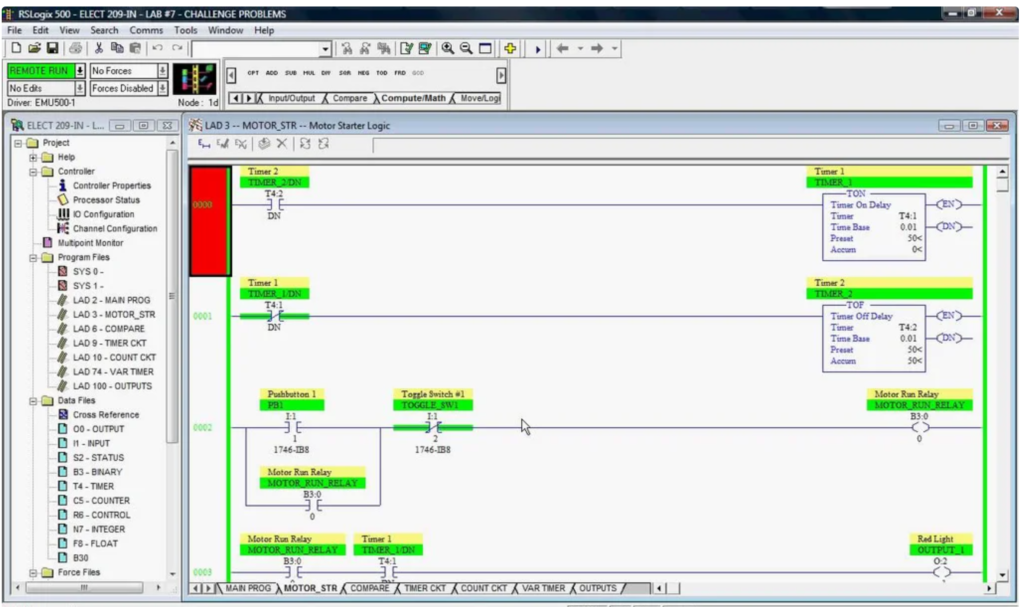
PLC programming languages are used to create control logic that allows programmable logic controllers to operate industrial machines and processes. Different programming languages are available to suit various control tasks, system complexities, and user preferences.
The most commonly used PLC programming languages include Ladder Logic (LD), Function Block Diagram (FBD), Structured Text (ST), and Sequential Function Chart (SFC). In this guide, we will explain each PLC programming language, how it works, and where it is commonly used in industrial automation systems.
What Are PLC Programming Languages?
PLC programming languages are standardized methods used to create control logic for programmable logic controllers. These languages allow engineers and technicians to define how machines, processes, and systems should operate based on inputs, conditions, and control sequences.
The most widely used PLC programming languages are defined under the IEC 61131-3 standard. Each language is designed for different types of control tasks, ranging from simple relay-based logic to complex mathematical and sequential operations.
Ladder Logic (LD) Explained
Ladder Logic is the most commonly used PLC programming language in industrial automation. It is designed to resemble traditional electrical relay logic, making it easy to understand for electricians and technicians.
Ladder Logic represents control logic based on PLC inputs and outputs using rungs, contacts, and coils. It is widely used for discrete control applications such as motor control, interlocking, and safety circuits. Because of its visual structure, Ladder Logic is often the first language taught to beginners.
Function Block Diagram (FBD) Explained
Function Block Diagram is a graphical PLC programming language that uses blocks to represent functions such as timers, counters, and mathematical operations. These blocks are connected together to show the flow of data and control logic.
FBD is commonly used in process control and applications where multiple control functions interact simultaneously. It is especially useful for visualizing complex control strategies and is widely used in industries such as chemical processing and power generation.
Structured Text (ST) Explained
Structured Text is a high-level, text-based PLC programming language that resembles traditional programming languages such as C or Pascal. It is well suited for applications that require complex calculations, data handling, and advanced control logic.
ST is commonly used in systems that involve mathematical operations, loops, and conditional statements. While it may be more challenging for beginners, Structured Text offers powerful capabilities and is widely used in modern industrial automation systems.
Sequential Function Chart (SFC) Explained
Sequential Function Chart is a graphical PLC programming language used to define sequential control processes. It breaks down complex operations into steps and transitions, making it easier to manage processes that follow a specific sequence.
SFC is often used in batch processes, material handling systems, and automated production lines. It provides a clear overview of process flow and helps simplify the design and troubleshooting of sequential control logic.
Comparison of PLC Programming Languages
Each PLC programming language has strengths suited to different applications. Ladder Logic is ideal for discrete control and maintenance-friendly systems, while Function Block Diagram excels in visualizing interconnected control functions.
Structured Text is preferred for complex logic and data processing, whereas Sequential Function Chart is best for managing step-based processes. Understanding these differences helps engineers choose the most effective language for a given automation task.
Which PLC Programming Language Should You Learn First?
For beginners, Ladder Logic is usually the best starting point because of its simplicity and widespread use in industry. It provides a strong foundation for understanding basic PLC concepts and control logic.
As experience grows, learning Function Block Diagram and Structured Text can help engineers learn PLC programming more effectively and improve problem-solving skills. The best approach is to start with one language and gradually learn others based on application requirements and career goals.